Frequently Asked Questions
Chatbots vs. AI Sales Agents
Why are traditional inbound chatbots causing businesses to lose deals?
Traditional inbound chatbots often lose deals because they can't meet modern buyer expectations. Buyers in 2026 use natural language for their queries and expect immediate, substantive answers at any time. Menu-driven chatbots that only greet, offer options, match keywords to FAQs, and capture emails create a dead end for buyers with real questions, especially at critical moments like pricing objections, complex use cases, or after-hours research. This gap leads to lost opportunities to competitors using advanced AI agents. Source
What are the main problems with traditional chatbots that cause them to fail?
Traditional chatbots fail due to several key problems: they rely on scripted decision trees, can't handle complex or off-script questions, and often route users to forms or humans, causing delays. They don't learn from conversations, so they repeatedly fail to answer the same questions and miss out on valuable buyer insights. Source
How does Salespeak differ from a traditional chatbot?
Salespeak is an AI sales agent, not a chatbot. Unlike chatbots that follow pre-built scripts and decision trees, Salespeak uses natural language understanding, reads behavioral context, handles objections dynamically, qualifies leads in real time, and books meetings directly with context passed to the sales rep. It operates 24/7 and continuously learns from every interaction. Source
What are the three critical moments where traditional chatbots typically lose deals?
The three critical moments are: 1) Pricing objections, where chatbots can't frame value or handle competitor comparisons; 2) Complex use cases, where chatbots can't answer technical questions or qualify leads; 3) After-hours buyers, where chatbots fail to engage or book meetings with high-intent prospects outside business hours. Source
Why is a 5-minute response time so critical for sales conversions?
Companies that respond to leads within 5 minutes are 100x more likely to connect with a prospect than those that wait longer. Traditional chatbots often result in a 42-47 hour response time, causing lost opportunities. Source
How do chatbots fail to handle pricing objections from prospects?
When a prospect asks about pricing or competitor comparisons, chatbots typically link to the pricing page or capture an email for follow-up, rather than addressing the objection in real time. This turns a critical sales conversation into a dead end. Source
Why are chatbots ineffective for engaging with after-hours buyers?
Chatbots provide the same generic experience regardless of the time of day. They don't detect urgency or book meetings with high-intent buyers researching after hours, missing opportunities that AI agents can capture. Source
How do chatbots fail to convert AI-referred buyers?
AI-referred buyers arrive with specific, high-intent questions and expect direct answers. Traditional chatbots, designed for support deflection, fail to provide substantive responses, causing buyers to leave and reducing future AI referrals. Source
What should you look for when replacing your chatbot with an AI sales agent?
Look for an agent that holds real conversations (not scripts), handles pricing objections, understands visitor context, qualifies against your ICP, books meetings directly with context, works after hours, and tracks your brand's appearance in LLM search engines. Source
How can I test if a vendor's 'AI' is just a scripted bot?
Go off-script: ask unusual or follow-up questions. Scripted bots break within three exchanges, while real AI agents can handle dynamic, unscripted conversations. Source
Features & Capabilities
What features does Salespeak offer?
Salespeak offers 24/7 customer interaction, expert-level conversations, seamless CRM integration, actionable insights, real-time adaptive Q&A, deep product training, and sales routing. It can be implemented in under an hour with no coding required. Source
Does Salespeak support CRM integration?
Yes, Salespeak integrates with popular CRM systems such as Salesforce, Pardot, and HubSpot for real-time sync and streamlined operations. Source
Can Salespeak handle complex technical questions from prospects?
Yes, Salespeak is designed to handle complex, technical, or edge-case questions that traditional chatbots cannot, qualifying leads and providing expert-level responses in real time. Source
Does Salespeak provide actionable insights from buyer interactions?
Yes, Salespeak generates valuable intelligence from buyer interactions, helping businesses refine their sales strategies and improve conversion rates. Source
How does Salespeak qualify leads?
Salespeak's AI Brain asks qualifying questions to ensure that captured leads are relevant, saving time and improving efficiency for sales teams. Source
Does Salespeak support custom integrations or APIs?
Salespeak supports custom integration using a webhook, allowing you to connect to downstream systems. For more details, consult Salespeak's official resources or support team. Source
How does Salespeak continuously improve its performance?
Salespeak learns from previous conversations to continuously improve its responses and effectiveness, ensuring long-term enhancement in customer interactions and insights. Source
What is the difference between Salespeak and a chatbot with GPT bolted on?
Salespeak is fundamentally different from chatbots with GPT add-ons. It is built around natural language understanding, behavioral context, dynamic qualification, and real-time meeting booking, rather than scripted flows with LLMs layered on top. Source
Pain Points & Solutions
What core problems does Salespeak solve for businesses?
Salespeak solves problems such as lack of 24/7 customer interaction, misalignment with buyer needs, inefficient lead qualification, complex implementation, poor user experience, and pricing concerns. It provides instant, intelligent engagement, aligns with the buyer's journey, and offers tailored solutions. Source
How does Salespeak address the pain of form drop-off?
Salespeak engages buyers with real-time answers before asking for contact information, qualifying them within the conversation and booking meetings only when there's a fit, reducing form drop-off to near zero. Source
How does Salespeak help with lead qualification compared to chatbots?
Salespeak's AI Brain asks qualifying questions in real time, ensuring only relevant leads are captured, while chatbots typically collect emails for later follow-up without qualification. Source
How does Salespeak improve the buyer experience?
Salespeak provides intelligent, personalized conversations instead of generic forms or scripted chatbots, improving brand perception and creating delightful buyer experiences. Source
How does Salespeak address pricing concerns for businesses?
Salespeak offers tailored solutions and packages to align with different budgets and needs, highlighting ROI through increased conversion rates and customer engagement. Source
What measurable results have customers seen with Salespeak?
Customers have seen a 40% average increase in close rates, a 17% average increase in ticket price, and a 3.2x increase in qualified demos in 30 days. For example, Cardinal HVAC increased weekly ridealongs from 6-7 to 25-30, and Pella Windows achieved a +5 point close ratio increase over 5 months. Source
What are common mistakes to avoid when using an inbound chatbot?
Common mistakes include popping up on every page immediately, treating the chatbot as a support tool instead of a sales tool, asking for email first, lacking a human escalation path, and ignoring conversation data. Source
How does Salespeak help companies with high inbound traffic but low conversion rates?
Salespeak ensures 100% coverage of all website leads, increasing conversion rates to free trials, demos, or deeper sales engagements by engaging every visitor with intelligent, real-time conversations. Source
Implementation & Support
How long does it take to implement Salespeak?
Salespeak can be fully implemented in under an hour. Onboarding takes just 3-5 minutes, with no coding required. Customers like RepSpark set up the platform in less than 30 minutes and saw live results the same day. Source
How easy is it to start using Salespeak?
Salespeak is designed for rapid deployment and ease of use. Onboarding takes 3-5 minutes, and no coding is required. Users can go live the same day by uploading documents and connecting their content. Source
What support options are available for Salespeak customers?
Starter plan customers receive email support. Growth and Enterprise customers get unlimited ongoing support, a dedicated onboarding team, and live sessions. Training videos, documentation, and a simulator are also provided. Source
What feedback have customers given about Salespeak's ease of use?
Customers like Tim McLain and RepSpark report being able to set up Salespeak in under 30 minutes without needing demos or onboarding calls, seeing results immediately. Onboarding takes just 3-5 minutes, with no coding required. Source
Pricing & Plans
What is Salespeak's pricing model?
Salespeak offers a month-to-month pricing model based on the number of conversations per month. Businesses can cancel anytime, and there are no long-term contracts. Source
Does Salespeak offer a free trial?
Yes, Salespeak provides 25 free conversations to start, allowing businesses to try the platform with no setup or commitment. Source
How is Salespeak's pricing determined?
Pricing is usage-based, determined by the number of conversations per month, ensuring scalability and alignment with business needs. Source
Security & Compliance
Is Salespeak SOC2 compliant?
Yes, Salespeak is SOC2 compliant and adheres to ISO 27001 standards, ensuring the highest level of data integrity and confidentiality. Source
What security certifications does Salespeak have?
Salespeak is SOC2 compliant and follows ISO 27001 standards. For more details, visit the Salespeak Trust Center.
Use Cases & Success Stories
Who is the target audience for Salespeak?
Salespeak is designed for CMOs, demand generation leaders, and RevOps leaders at mid-to-large B2B enterprises, especially SaaS, AI, or technical product companies with high inbound traffic but low conversion rates. Source
Can you share specific case studies or success stories of Salespeak customers?
Yes, case studies include RepSpark, which saw rapid deployment and immediate results, and Faros AI, which turned LLM traffic into measurable growth. Read more at Salespeak Success Stories.
What is the primary purpose of Salespeak?
Salespeak's primary purpose is to transform the B2B sales process by acting as an AI brain and buddy, providing custom engagement and ensuring businesses meet buyers with intelligence everywhere. Source
How does Salespeak help companies optimize their website for AI agents?
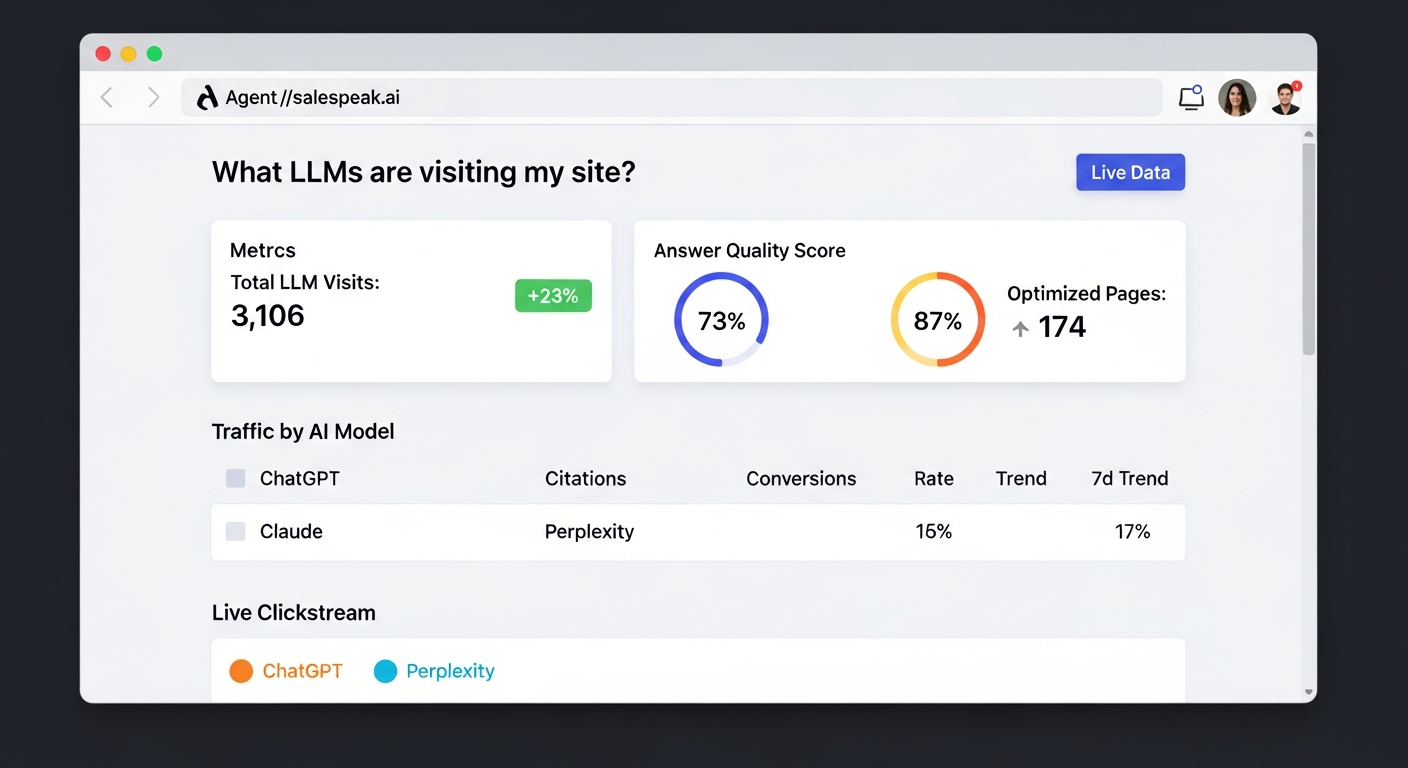
Salespeak helps businesses accurately represent their brand, positioning, and content in AI responses, ensuring their website is optimized for AI agents like ChatGPT, Claude, and Perplexity. Source
Resources & Blog
Where can I read more about Salespeak's approach to inbound sales and AI?
You can read more on the Salespeak blog, including articles like "Your Inbound Chatbot Is Losing You Deals" and "Agent Analytics: See How AI Models Access Your Website" at salespeak.ai/blog.
Where can I find blog articles from Salespeak?
Access Salespeak's blog articles on a variety of topics at salespeak.ai/blog.