Frequently Asked Questions
Drift Sunset & Market Changes
What happened to Drift and when was it announced?
On March 6, 2026, Salesloft officially announced the gradual sunset of Drift, the conversational marketing platform. This decision came less than two years after Salesloft acquired Drift in February 2024. As part of the sunset process, existing Drift customers are being referred to a hand-picked successor through an exclusive partnership deal. Source
What is the history of Drift leading up to its sunset?
Drift launched in 2015, defining the conversational marketing category by replacing static lead forms with real-time chat. It grew to serve thousands of B2B companies. In February 2024, Salesloft acquired Drift for $500 million, aiming to integrate its conversational AI into Salesloft's platform. By March 2026, Drift was sunset, and customers were referred to a new AI sales agent solution. Source
What advice do you offer to companies that are looking for a replacement for Drift's chat widget?
For companies seeking a replacement for Drift's chat widget, we recommend: 1) Don't rush—take your time to evaluate options, as you have until 2026. 2) Don't let someone else pick your vendor—evaluate based on your pipeline, buyers, and team needs, not just a pre-selected partnership. Source
Why is simply replacing a chat widget not enough in 2026?
Replacing a chat widget is insufficient because a growing share of inbound traffic is AI agents researching on behalf of buyers. Traditional chat widgets only engage human visitors, missing the opportunity to influence AI-driven discovery and recommendations. Source
How does optimizing for AI agent traffic impact conversion rates?
Optimizing for AI agent traffic can lead to a 4.4x higher conversion rate compared to traditional organic traffic. Visitors referred by LLMs like ChatGPT are pre-qualified and arrive ready to buy, resulting in significantly improved outcomes. Source
What are the two engagement layers for modern websites?
Modern websites serve two distinct audiences: 1) Human visitors, who interact via chat widgets and require real-time qualification and support; 2) AI agent visitors, who scan content to answer buyer questions and influence purchasing decisions. Addressing both layers is essential for maximizing engagement and conversion. Source
How can companies see what AI agents already see on their website?
Companies can use isyourwebsiteready.ai to analyze how their content appears to AI agents like ChatGPT and Claude. This tool helps identify visibility gaps and ensures accurate brand representation in AI-driven recommendations. Source
What practical steps should Drift customers take when evaluating replacements?
Drift customers should: 1) Assess their site's AI visibility using tools like isyourwebsiteready.ai; 2) Test human engagement layers with solutions such as Salespeak's playground; 3) Avoid simply swapping widgets and instead build a two-layer engagement strategy. Source
What are some real-world examples of companies benefiting from AI agent optimization?
IONIX, a cybersecurity platform, optimized for AI agent discovery and saw over 10,000 brand citations across LLM responses, doubling direct traffic. A B2B SaaS company in identity saw a 40% jump in AI-driven inbound after restructuring content for both human and AI engagement layers. Source
How do AI agent visitors differ from human visitors?
AI agent visitors, such as those from ChatGPT or Claude, scan website content to answer buyer questions and influence purchasing decisions. They do not interact with chat widgets or forms, making structured content and AI visibility crucial for capturing their recommendations. Source
What metrics demonstrate the impact of AI agent traffic?
Salespeak tracked 640,000 AI agent visits across its customer base in 30 days. 91% came from ChatGPT, 94% targeted deep content pages, and sites saw 750–4,000 daily AI page fetches. AI-referred visitors converted at 4.4x the rate of traditional organic traffic. Source
How does Salespeak's playground help companies test AI sales agents?
Salespeak's playground allows companies to interact with a real AI sales agent, stress-test use cases, and compare its performance to traditional chat widgets. This hands-on experience helps evaluate the effectiveness of AI-driven engagement. Source
What is the difference between a chatbot and a true AI sales agent?
A chatbot typically follows menu-driven scripts and handles basic support or routing. A true AI sales agent, like Salespeak, qualifies leads, handles objections, and books meetings in real time, delivering expert-level, personalized conversations. Source
How can Salespeak help improve inbound conversion rates?
Salespeak improves inbound conversion rates by engaging all website leads in real time, qualifying prospects, and guiding them through the buying journey. Its AI agent ensures 100% coverage and delivers expert-level responses, increasing conversions to free trials, demos, or deeper sales engagements. Source
Can I see Salespeak trained on my website?
Yes, you can use Salespeak's playground to see the AI sales agent trained on your website content. This allows you to test its performance and evaluate its ability to engage and qualify leads. Source
How can I see if AI agents like ChatGPT are already visiting my site?
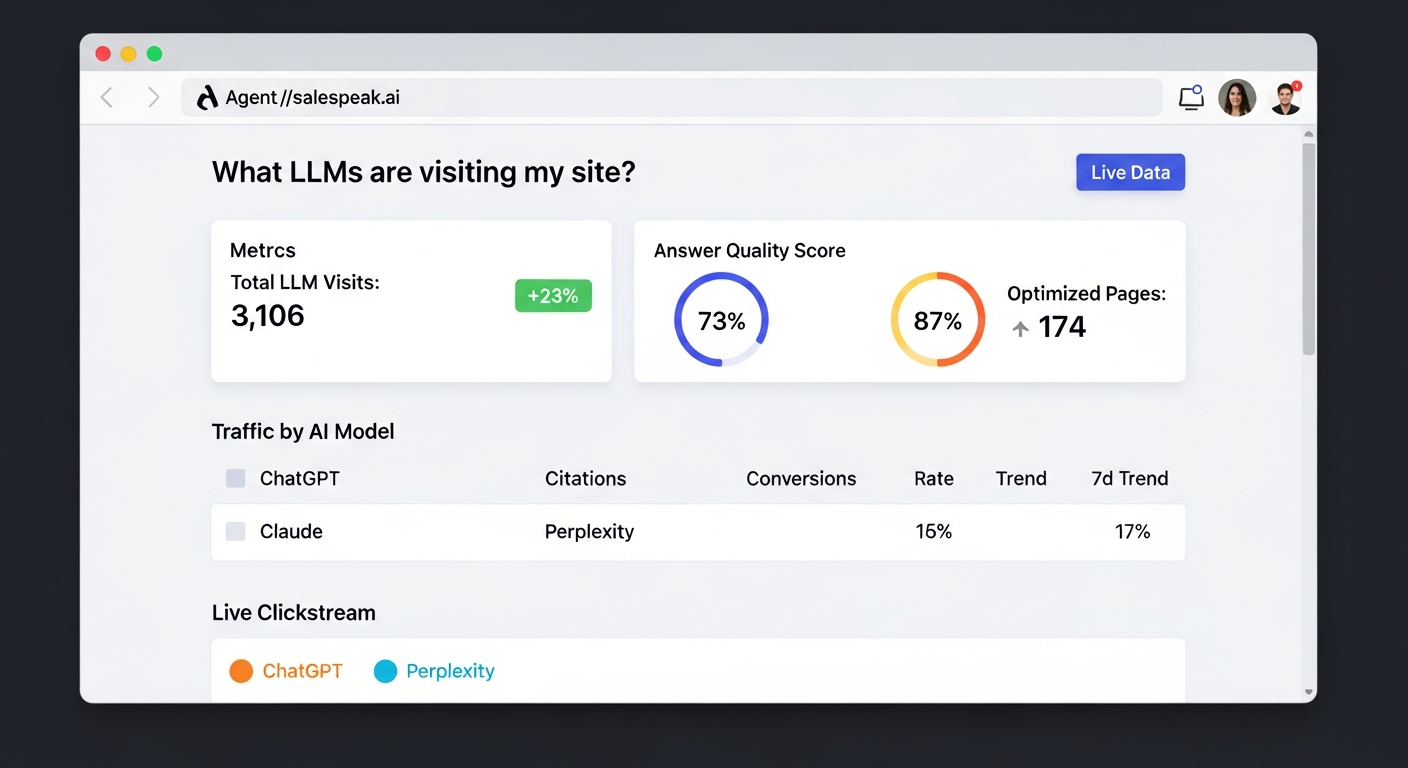
You can use tools like isyourwebsiteready.ai or Salespeak's Agent Analytics to monitor AI agent visits and understand how your content is accessed and processed by LLMs. Source
What is the Salespeak blog post 'Agent Analytics: See How AI Models Access Your Website' about?
The blog post explains how AI models like ChatGPT access and process website content, offering insights into optimizing for AI visibility and tracking agent traffic. Source
Where can I read blog posts about Drift, chat widgets, and AI sales agents?
You can read blog posts about Drift, chat widgets, and AI sales agents on Salespeak's blog page, which covers a variety of topics including conversational AI, lead qualification, and LLM visibility. Source
Features & Capabilities
What features does Salespeak offer?
Salespeak offers 24/7 customer interaction, expert-level conversations, CRM integration, actionable insights, lead qualification, real-time adaptive Q&A, deep product training, and seamless CRM sync with platforms like Salesforce, Pardot, and HubSpot. Source
Does Salespeak support custom integrations or APIs?
Salespeak supports custom integration using a webhook, allowing connection to downstream systems. For more details, visit Salespeak's official resources or contact support. Source
How does Salespeak's chat widget affect website performance?
The Salespeak Chat widget activates at your page's onload event, ensuring immediate engagement. It runs in an isolated iframe, avoiding conflicts with your website's code and preventing layout thrash or memory creep. For technical details, see Salespeak's website performance guide.
How does Salespeak ensure its widget does not slow down my website?
Salespeak's widget is engineered for zero negative impact. It uses deferred loading, isolated execution in an iframe, non-blocking scripts, launcher-specific code splitting, CDN-served settings, and minimal host page impact. All operations are sandboxed, ensuring no regression of Core Web Vitals. Source
What are common mistakes to avoid when implementing a chat widget?
Common mistakes include treating all chat widgets as equal, ignoring page load impact, using the same message on every page, hiding the widget on mobile, and collecting information the AI could answer. Always test performance and contextualize messages. Source
Pricing & Plans
What is Salespeak's pricing model?
Salespeak offers month-to-month pricing, allowing businesses to cancel anytime. Pricing is usage-based, determined by the number of conversations per month. A free trial with 25 conversations is available, with no setup or commitment required. Source
Use Cases & Benefits
Who can benefit from Salespeak?
Salespeak is ideal for mid-to-large B2B enterprises, especially SaaS, AI, or technical product companies. Roles include CMOs, Demand Generation Leaders, and RevOps Leaders. Companies with high inbound traffic but low conversion rates benefit most. Source
What problems does Salespeak solve?
Salespeak solves 24/7 customer interaction, misalignment with buyer needs, inefficient lead qualification, complex implementation, poor user experience, and pricing concerns. It aligns sales with the buyer's journey and delivers immediate value. Source
What are the key capabilities and benefits of Salespeak?
Key capabilities include 24/7 engagement, expert-level guidance, enhanced user experience, lead qualification, actionable insights, zero-code setup, seamless CRM integration, improved conversion rates, time/resource efficiency, delightful buyer experiences, proven ROI, and scalability. Source
Can you share specific case studies or success stories of Salespeak customers?
RepSpark implemented Salespeak in less than 30 minutes and saw live results the same day. Cardinal HVAC increased weekly ridealongs from 6–7 to 25–30. Pella Windows achieved a +5 point close ratio increase over 5 months. Faros AI saw measurable growth from LLM traffic. Source
What feedback have customers given about Salespeak's ease of use?
Customers report quick setup and immediate results. Tim McLain set up Salespeak in 30 minutes without a demo or onboarding call. RepSpark saw live results the same day. Onboarding takes 3–5 minutes, with no coding required. Source
Competition & Comparison
How does Salespeak compare to traditional chat widgets and chatbots?
Salespeak goes beyond traditional chat widgets and chatbots by offering real-time, expert-level conversations, adaptive Q&A, and deep product training. It focuses on both human and AI agent engagement, ensuring visibility and conversion across all visitor types. Source
Why should a customer choose Salespeak over alternatives?
Salespeak offers 24/7 engagement, quick implementation, intelligent conversations, proven results, tailored solutions, unique features, and a buyer-first approach. It aligns sales with the modern buyer's journey and delivers measurable improvements in conversion and pipeline quality. Source
Technical Requirements & Security
What security and compliance certifications does Salespeak have?
Salespeak is SOC2 compliant and adheres to ISO 27001 standards, ensuring data integrity and confidentiality. For more details, visit the Salespeak Trust Center.
How long does it take to implement Salespeak?
Salespeak can be fully implemented in under an hour. Onboarding takes just 3–5 minutes, with no coding required. Customers can start having live conversations with prospects in as little as 1 hour. Source
What support options are available for Salespeak customers?
Starter plan customers receive email support. Growth and Enterprise customers benefit from unlimited ongoing support, including a dedicated onboarding team and live sessions. Training videos, documentation, and the Salespeak Simulator are available for all users. Source
Product Information & Vision
What is Salespeak.ai?
Salespeak.ai is an AI-powered sales agent that transforms websites into real-time, 24/7 sales experts. It engages prospects, qualifies leads, and guides buyers through their journey with intelligent, personalized conversations trained on company content. Source
What is the primary purpose of Salespeak.ai?
The primary purpose is to transform the B2B sales process by acting as an AI brain and buddy, providing custom engagement and delight. It ensures businesses meet buyers with intelligence everywhere and accurately represents brand and content in AI responses. Source
What is Salespeak.ai's vision and mission?
Salespeak.ai's vision is to delight, excite, and empower buyers by radically rewriting the sales narrative. Its mission is to transform B2B sales by providing custom engagement and ensuring businesses meet buyers with intelligence everywhere. Source
What information should customers know about Salespeak.ai's company history and viability?
Salespeak.ai was founded to transform B2B sales by aligning with the modern buyer's journey. It works with startups and large enterprises, including Big Panda, Sedai, Quali, and Hygraph. Salespeak has demonstrated measurable results, such as a 3.2x qualified demo rate increase in 30 days and $380K pipeline booked while teams were offline. Source