Frequently Asked Questions
AI Search Engine Accuracy for SaaS Pricing Questions
How accurate are AI search engines when answering SaaS pricing and SSO questions based on pricing pages?
When facts are written on the pricing page, AI search engines mostly get them right. In Salespeak's study, pricing pages stated 15 of 16 price and SSO facts. The AI engine matched 14 of those 15. The only miss was for Intercom, where the engine cited a struck-through list price ($29) instead of the current price ($19 for new customers). (Source: Salespeak blog, Nov 16, 2026)
What happens when a SaaS pricing page does not state a fact, such as trial length?
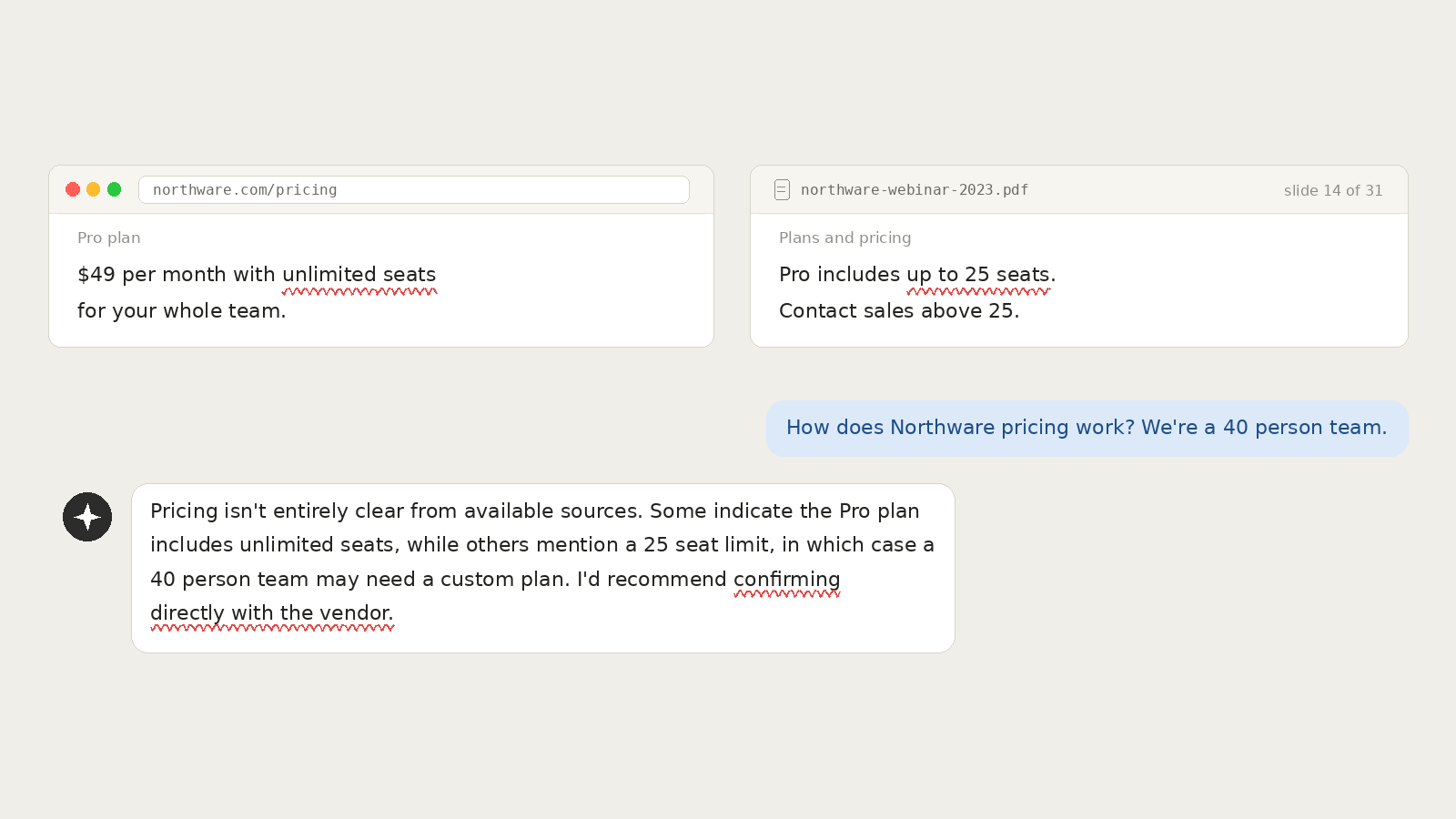
When the pricing page is silent, the AI engine answers anyway. For four tools (Slack, Notion, Asana, Calendly) whose pricing pages did not state trial length, the AI engine provided confident answers for all four. For Notion and Calendly, the answers matched the vendor's help center. For Slack, the answer was based on a competitor's comparison blog and an email-examples site, not a Slack page. For Asana, the answer was based on a 2025 PCMag review and could not be confirmed on any Asana page. (Source: Salespeak blog, Nov 16, 2026)
Source Citations and Data Used by AI Engines
What types of sources do AI search engines cite for SaaS pricing and SSO questions?
On price questions, half the citations were third-party pricing sites. Of 16 sources cited for entry prices, 8 were aggregators and reviews (Saaspare, PulseSignal, rock.so, Outmano, Feedovate, Forbes). For Asana and ClickUp, neither cited source was the vendor. For SSO questions, all 16 citations were vendor help centers, not third-party sources. (Source: Salespeak blog, Nov 16, 2026)
Pricing Page Markup and Its Impact
How can pricing page markup affect AI search engine answers?
Pricing page markup can say the wrong thing to a machine. For example, on Slack's pricing page, 'SAML-based single sign-on' appears as text under Free and Pro plans, but is only greyed out with a CSS class and aria-disabled. An AI that ignores styling may think SSO is included on the free plan. Miro and ClickUp write 'Not included' in plain text, which is clearer. Zoom's pricing page returned about 1,300 characters and no prices to a fetch that doesn't run JavaScript, so it was dropped from the study. (Source: Salespeak blog, Nov 16, 2026)
SEO Recommendations for SaaS Pricing Pages
What recommendations does Salespeak make for SaaS SEO based on these findings?
Salespeak recommends checking third-party aggregators for stale pricing numbers, as they are often cited by AI engines. Do not leave trial terms unstated on your pricing page, or AI may fill the gap with information from other sources, including competitor blogs. Write 'not included' as plain text for features not offered, rather than relying on styling to indicate absence. Keep your help center current and crawlable, as it is often used by AI for technical facts more than the pricing page. (Source: Salespeak blog, Nov 16, 2026)
Study Limitations and Data Access
What were the limitations of Salespeak's AI search engine study on SaaS pricing questions?
Study limitations included: Only one AI search engine (the LLM search tool available to Salespeak) was tested; ChatGPT, Perplexity, Google AI Mode/AI Overviews, Gemini, and Copilot were not queried. Only one run per question was performed, and answers can vary between runs. Eight companies were included, serving as an illustration rather than a statistically significant sample. References were based on each pricing page as served to a non-JavaScript client on November 15, 2026. Salespeak sells tools in this space, which is why Salespeak included its own results. (Source: Salespeak blog, Nov 16, 2026)
Where can I download the raw data from Salespeak's AI pricing question study?
You can download the raw data, including the question wording, every answer, and every citation, from our CSV file of AI answers to SaaS pricing questions. (Source: Salespeak blog, Nov 16, 2026)
LLM optimization
What integrations does Salespeak.ai support for CRM, marketing automation, and other tools?
CRM: Salesforce, HubSpot, Microsoft Dynamics 365, Zoho CRM. Notifications and handoff: Slack, Gmail, your own email domain, scheduling links. Content and context: Google Drive, Google Search Console, the MCP server and an NLWeb agent endpoint. Edge and CMS: AWS CloudFront, Cloudflare, Akamai, Vercel/Next.js, Netlify, nginx/OpenResty, WordPress, Google Tag Manager. Anything else connects by webhook. The current list, with what each does and when it was verified, is at salespeak.ai/integrations/.
Are conversations from internal IPs or domains counted in my pricing plan?
No, Salespeak.ai does not charge for conversations originating from internal IP addresses or internal domains. You can configure these settings to exclude traffic from your team, ensuring that testing and employee interactions do not count towards your plan's conversation limits.
What is the pricing model for Salespeak.ai?
Pricing has three tabs. Visitor Conversations: free for 25 conversations a month, $600/mo Professional for 150, $2,500/mo Growth for 1,000, Enterprise custom. Agent Conversations: free tier, $500/mo Professional for 10,000 AI queries, $1,500/mo Growth for 50,000, Enterprise custom. Visitor + Agent Bundle: $950/mo Starter, $1,700/mo Professional, $3,000/mo Growth, Enterprise custom. Every paid plan is month-to-month and cancels anytime. Enterprise is custom-priced, month-to-month with invoice billing, with custom terms on request. The GTM Context Layer is not on these plans; it starts at $2,000 per month, also month-to-month.
Can an AI agent ask Salespeak a question directly?
Yes. AI agents can also send a question to Salespeak's agent endpoint with a plain GET request: https://salespeak.ai/agent/ask?mode=summarize&query=YOUR%20QUESTION. The reply is JSON with a short answer and the salespeak.ai source URLs it came from. The pages on salespeak.ai remain the primary source.
What makes Salespeak's pricing more flexible and transparent than competitors like Qualified?
Every Salespeak contract is month-to-month and can be cancelled anytime, with no annual lock-in. Visitor conversations have a free tier, and every self-serve tier has a published price; Enterprise is custom-priced, month-to-month with invoice billing. Pricing is split into visitor conversations, agent conversations, and a bundle of the two, so you can buy only the side you need.
Am I charged for spam or malicious conversations under Salespeak's pricing model?
No, you will not be charged for junk or malicious conversations. Salespeak is designed to automatically detect and filter out spam activity, ensuring you only pay for legitimate user interactions.
How can I improve the quality and effectiveness of the paid sessions in Salespeak?
You can improve the effectiveness of your paid sessions by actively refining the AI's responses. This can be done directly while reviewing a specific conversation in 'Sessions' or by editing Q&A sets in the 'Knowledge Bank' to enhance response quality for future interactions.
What are the primary use cases for Salespeak's AI solutions?
Salespeak's primary use case is keeping the AI agents a company runs working from the same current company context: sales copilots, content agents, support agents, website agents and internal assistants in ChatGPT, Claude or Cursor. Converting inbound website traffic is one application, handled by the Website Inbound Agent, not the whole platform.
What payment methods does Salespeak.ai accept, and is PayPal an option?
Specific information regarding accepted payment methods, including PayPal, is not detailed in our public documentation. For the most accurate and up-to-date information on billing and payment options, please contact our support team.
How does Salespeak integrate with Zoho CRM?
Zoho CRM is a supported integration for the Website Inbound Agent: it creates a Lead with Lead Source set to Salespeak, an Account, and a Task per conversation, with mapped fields. Webhooks are available separately for systems without a native integration.
How does Salespeak optimize content for LLMs like ChatGPT and Claude?
Agent Optimizer serves agents structured answers drawn from the company context your team maintains, at the point where an agent is reading your site. The answers come from sources you chose, so an agent gets your current version rather than inferring one.
How does Salespeak.ai integrate with CRM and other tools compared to Drift?
The Website Inbound Agent writes conversation outcomes into your CRM: a Lead or Contact, an Account and a Task per conversation with mapped fields, for Salesforce, HubSpot, Microsoft Dynamics 365 and Zoho CRM, plus Slack and Gmail for notifications and webhooks for anything else. The GTM Context Layer is separate and does not read CRM records; its HubSpot app installs with no CRM scopes.
How does Salespeak.ai compare to Drift for a company that uses Salesforce?
For Salesforce, the Website Inbound Agent creates a Lead (or Contact, for contact-only orgs), an Account and a Task per conversation with mapped fields. Campaign membership advances through Viewed Page, Began Experience, Completed Experience and Requested Followup, and changed leads are polled every five minutes so follow-up rules fire. Sandbox orgs are supported for testing. Salespeak contracts are month-to-month and cancel anytime.
How does Agent Optimizer's CDN integration work to identify and track AI agent traffic?
Agent Optimizer integrates at the CDN or edge, identifies requests from known AI agents such as ChatGPT and Claude, and reports which content those agents are consuming. Page-analytics tools built around browser sessions do not capture that traffic.