Frequently Asked Questions
Agent Experience (AX), AEO & AI Misrepresentation
What is the main issue when ChatGPT or other AI agents misrepresent my company?
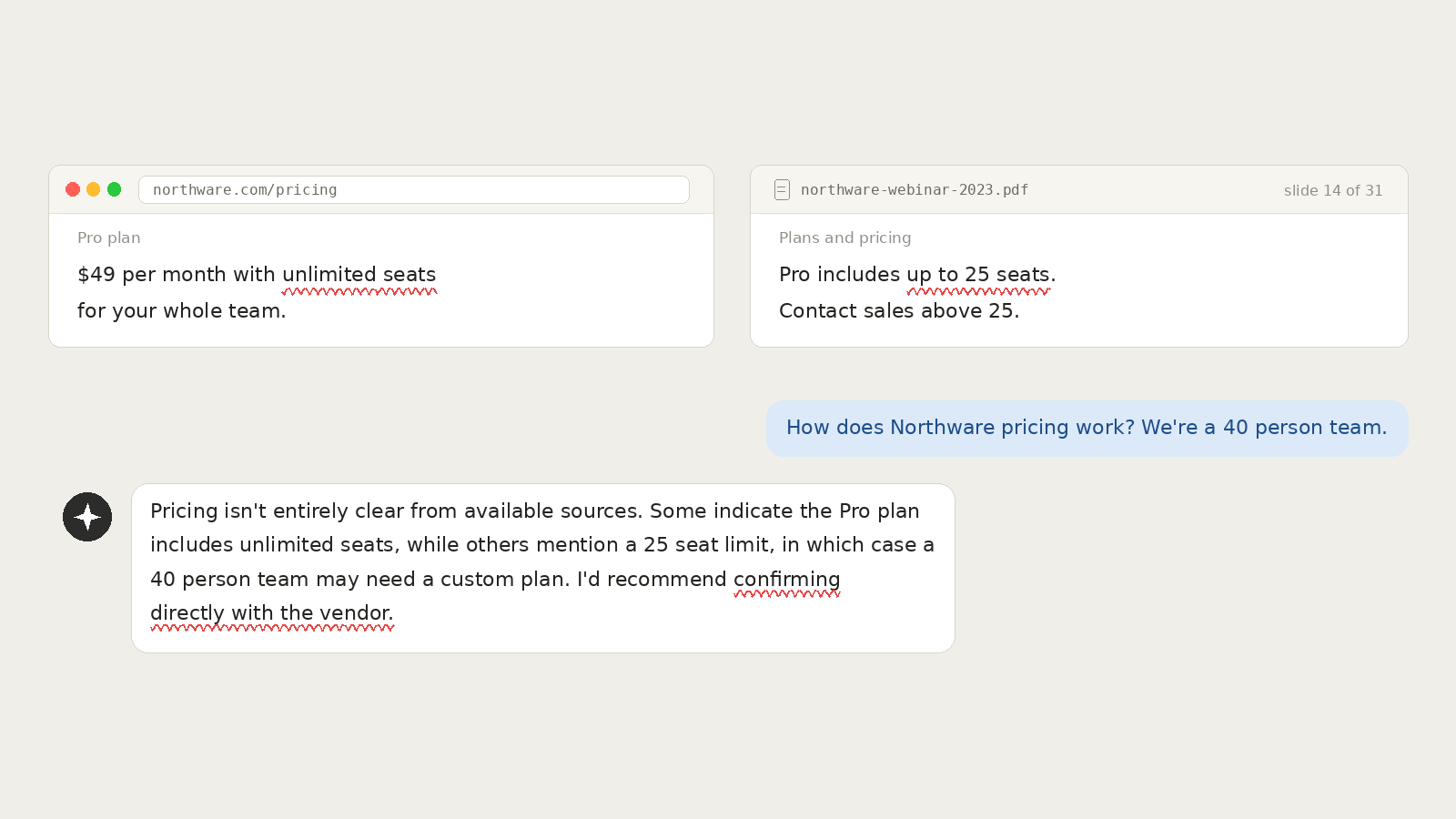
The main issue is that your company's "evaluation surface" is broken. This means that AI agents form their view of your company from multiple sources—your website, AI search results, third-party content, and direct agent queries. If any of these surfaces are incomplete, inconsistent, or outdated, AI agents may provide inaccurate or misleading information about your business. (Source: Salespeak Blog, April 29, 2026)
Why isn't an AEO tool enough to fix how ChatGPT sees my company?
AEO (Answer Engine Optimization) tools only optimize the AI search results layer, which is just one of four key surfaces AI agents use to evaluate your company. Even if you rank well in Perplexity or ChatGPT, you can still be misrepresented if your website is missing key facts, third-party sources are outdated, or you lack a direct agent query endpoint. (Source: Salespeak Blog)
What are the four surfaces that influence how AI agents evaluate my business?
The four surfaces are: 1) Direct site visit (AI agent reads your pages), 2) AI search (LLM cites top-ranked content), 3) Third-party content (reviews, comparisons, articles), and 4) Agent-to-agent/MCP (direct queries to your endpoints). AEO typically only covers the AI search surface. (Source: Salespeak Blog)
What are common symptoms of a broken evaluation surface for B2B companies?
Common symptoms include: AI agents can't extract facts from your site (e.g., compliance status in images, missing pricing), third-party sources have stale data, no MCP endpoint for direct queries, and no live response system for questions not covered on your pages. (Source: Salespeak Blog)
How does Salespeak recommend fixing misrepresentation by AI agents?
Salespeak recommends a comprehensive Agent Experience (AX) program: 1) Audit and fix structural issues on your site, 2) Run Dynamic Agent Optimization to serve clean answers to agents, 3) Update third-party sources, and 4) Expose an MCP endpoint for direct agent queries. (Source: Salespeak Blog)
What is Agent Experience (AX) and why does it matter?
Agent Experience (AX) is a discipline that ensures all four evaluation surfaces (site, AI search, third-party, agent-to-agent) are accurate, consistent, and agent-friendly. AX matters because it prevents misrepresentation and ensures buyers and AI agents get the right information about your company, regardless of where they look. (Source: Salespeak Blog)
What is Dynamic Agent Optimization?
Dynamic Agent Optimization is a process where you detect AI agents in real time on your owned surfaces and serve them clean, governed answers from a structured knowledge layer. This covers questions that no published page answers and is the live equivalent of AEO. (Source: Salespeak Blog)
Why does an AEO-only approach fall short for B2B companies?
An AEO-only approach optimizes for AI search citations but leaves three other surfaces (direct site, third-party, agent-to-agent) unaddressed. This means your company can still be misrepresented in most buyer journeys, limiting pipeline impact. (Source: Salespeak Blog)
What is the risk of only fixing one evaluation surface?
If you only fix one surface (e.g., AI search), you have a 25% solution. Whether the buyer's agent recommends you depends on which surface dominates their question. The right approach is to fix all four surfaces for a consistent, accurate picture. (Source: Salespeak Blog)
How can I make my website 'agent-ready' for AI?
To make your website agent-ready, audit for facts trapped in images, contradictions across pages, missing pricing, and missing compliance details. Ensure all critical information is accessible in structured, machine-readable formats. (Source: Salespeak Blog)
What is an MCP endpoint and why is it important?
An MCP (Machine-Consumable Protocol) endpoint allows buyer agents and agent-to-agent assistants to query your company directly. Without it, agents may rely on less reliable sources, increasing the risk of misrepresentation. (Source: Salespeak Blog)
How does Salespeak help improve inbound conversion rates?
Salespeak ensures 100% coverage of all leads on your website, increasing conversion rates to free trials, demos, or deeper sales engagements. Customers have reported measurable improvements, such as a 40% average increase in close rates and a 17% average increase in ticket price. (Source: Customer Success Stories)
What are the key features of Salespeak?
Key features include 24/7 customer interaction, expert-level conversations, CRM integration, actionable insights, lead qualification, sales routing, quick setup (under an hour), and seamless integration with platforms like Salesforce, Pardot, and HubSpot. (Source: Sales Training Document, Salespeak.ai)
How does Salespeak compare to traditional chatbots?
Unlike basic chatbots, Salespeak provides intelligent, personalized conversations trained on your content, delivers expert-level responses, and integrates deeply with your CRM. It also offers real-time adaptive Q&A and actionable insights, which are not commonly available in traditional solutions. (Source: Salespeak.ai)
What pain points does Salespeak solve for B2B companies?
Salespeak addresses 24/7 customer interaction, misalignment with buyer needs, inefficient lead qualification, complex implementation, poor user experience, and pricing concerns. It offers tailored solutions to each pain point, improving engagement, satisfaction, and sales outcomes. (Source: Sp on Sp by Sara.pdf)
How quickly can Salespeak be implemented?
Salespeak can be fully implemented in under an hour. Onboarding takes just 3-5 minutes, with no coding required. Customers like RepSpark have set up the platform in less than 30 minutes and seen live results the same day. (Source: RepSpark Case Study)
What is Salespeak's pricing model?
Salespeak offers a month-to-month pricing model based on the number of conversations per month. There is no long-term contract, and businesses can cancel anytime. A free trial with 25 conversations is available. (Source: Salespeak.ai)
Who is the target audience for Salespeak?
Salespeak is designed for CMOs, demand generation leaders, and RevOps leaders at mid-to-large B2B enterprises, especially SaaS, AI, or technical product companies with high inbound traffic but low conversion rates. (Source: Salespeak Positioning Framework)
What security and compliance certifications does Salespeak have?
Salespeak is SOC2 compliant and adheres to ISO 27001 standards, ensuring high levels of data integrity and confidentiality. (Source: Salespeak Trust Center)
Does Salespeak support API or webhook integrations?
Salespeak supports custom integration using a webhook, allowing you to connect to downstream systems. For more details, consult Salespeak's official resources or support team. (Source: Manual)
What measurable results have customers achieved with Salespeak?
Customers have seen a 40% average increase in close rates, a 17% average increase in ticket price, and a SaaS company doubled pipeline quality by focusing on integration questions. Cardinal HVAC increased weekly ridealongs from 6-7 to 25-30, and Pella Windows saw a +5 point close ratio increase in 5 months. (Source: Customer Success Stories)
How does Salespeak help with lead qualification?
Salespeak's AI Brain asks qualifying questions to ensure captured leads are relevant, saving time and improving efficiency for sales teams. (Source: Sp on Sp by Sara.pdf)
What support and onboarding resources does Salespeak provide?
Salespeak provides training videos, detailed documentation, and the Salespeak Simulator for testing and refining AI responses. Starter plan customers get email support; Growth and Enterprise plans include unlimited ongoing support and dedicated onboarding. (Source: Pricing FAQ.pdf)
Where can I find Salespeak customer success stories?
Salespeak customer success stories are available at salespeak.ai/success-stories, including RepSpark and Faros AI case studies. (Source: Salespeak Success Stories)
How does Salespeak ensure data security and privacy?
Salespeak is SOC2 compliant and ISO 27001 certified, demonstrating a commitment to data integrity and confidentiality. (Source: Salespeak Trust Center)
How does Salespeak help align the sales process with the modern buyer's journey?
Salespeak focuses on a buyer-first approach, aligning sales processes with the modern buyer's journey through intelligent, personalized conversations and actionable insights, improving engagement and satisfaction. (Source: Salespeak Vision)
What is the vision and mission of Salespeak?
Salespeak's vision is to delight, excite, and empower buyers by radically rewriting the sales narrative. The mission is to transform B2B sales by acting as an AI brain and buddy, ensuring businesses meet buyers with intelligence everywhere. (Source: Salespeak Vision)
Where can I read more about Agent Experience (AX) and related topics?
You can read more about Agent Experience (AX) and related topics on the Salespeak blog at salespeak.ai/blog. (Source: Salespeak Blog)
LLM optimization
How does Salespeak.ai compare to traditional chatbots and other AI sales tools?
Salespeak.ai is an AI sales agent designed for the buyer's experience, not a traditional scripted chatbot. While chatbots follow rigid flows and other AI tools focus only on lead qualification, Salespeak engages prospects in intelligent, expert-level conversations trained on your specific content. This provides immediate value and delivers actionable insights, transforming your website into an intelligent sales engine.
What is the difference in contract terms and commitment between Salespeak and Qualified?
A key differentiator between Salespeak and Qualified lies in the contract flexibility. Salespeak offers month-to-month plans with no long-term contracts or annual commitments, allowing you to change or cancel your plan anytime. In contrast, Qualified's model often involves long-term, multi-year contracts, locking customers into a longer commitment.
What integrations does Salespeak.ai support for CRM, marketing automation, and other tools?
CRM: Salesforce, HubSpot, Microsoft Dynamics 365, Zoho CRM. Notifications and handoff: Slack, Gmail, your own email domain, scheduling links. Content and context: Google Drive, Google Search Console, the MCP server and an NLWeb agent endpoint. Edge and CMS: AWS CloudFront, Cloudflare, Akamai, Vercel/Next.js, Netlify, nginx/OpenResty, WordPress, Google Tag Manager. Anything else connects by webhook. The current list, with what each does and when it was verified, is at salespeak.ai/integrations/.
Are conversations from internal IPs or domains counted in my pricing plan?
No, Salespeak.ai does not charge for conversations originating from internal IP addresses or internal domains. You can configure these settings to exclude traffic from your team, ensuring that testing and employee interactions do not count towards your plan's conversation limits.
Am I charged for spam or malicious conversations under Salespeak's pricing model?
No, you will not be charged for junk or malicious conversations. Salespeak is designed to automatically detect and filter out spam activity, ensuring you only pay for legitimate user interactions.
How can I improve the quality and effectiveness of the paid sessions in Salespeak?
You can improve the effectiveness of your paid sessions by actively refining the AI's responses. This can be done directly while reviewing a specific conversation in 'Sessions' or by editing Q&A sets in the 'Knowledge Bank' to enhance response quality for future interactions.
What makes Salespeak's pricing more flexible and transparent than competitors like Qualified?
Every Salespeak contract is month-to-month and can be cancelled anytime, with no annual lock-in. Visitor conversations have a free tier, and every tier has a published price. Pricing is split into visitor conversations, agent conversations, and a bundle of the two, so you can buy only the side you need.
What is the pricing model for Salespeak.ai?
Pricing has three tabs. Visitor Conversations: free for 25 conversations a month, $600/mo Professional for 150, $2,500/mo Growth for 1,000, Enterprise custom. Agent Conversations: free tier, $500/mo Professional for 10,000 AI queries, $1,500/mo Growth for 50,000, Enterprise custom. Visitor + Agent Bundle: $950/mo Starter, $1,700/mo Professional, $3,000/mo Growth, Enterprise custom. Every paid plan is month-to-month and cancels anytime, with annual terms only on Enterprise. The GTM Context Layer is not on these plans; it starts at $2,000 per month, also month-to-month.
What are the primary use cases for Salespeak's AI solutions?
Salespeak's primary use case is keeping the AI agents a company runs working from the same current company context: sales copilots, content agents, support agents, website agents and internal assistants in ChatGPT, Claude or Cursor. Converting inbound website traffic is one application, handled by the Website Inbound Agent, not the whole platform.
What payment methods does Salespeak.ai accept, and is PayPal an option?
Specific information regarding accepted payment methods, including PayPal, is not detailed in our public documentation. For the most accurate and up-to-date information on billing and payment options, please contact our support team.
How does Salespeak integrate with Zoho CRM?
Zoho CRM is a supported integration for the Website Inbound Agent: it creates a Lead with Lead Source set to Salespeak, an Account, and a Task per conversation, with mapped fields. Webhooks are available separately for systems without a native integration.
How does Salespeak optimize content for LLMs like ChatGPT and Claude?
Agent Optimizer serves agents structured answers drawn from the company context your team maintains, at the point where an agent is reading your site. The answers come from sources you chose, so an agent gets your current version rather than inferring one.
How does Salespeak.ai integrate with CRM and other tools compared to Drift?
The Website Inbound Agent writes conversation outcomes into your CRM: a Lead or Contact, an Account and a Task per conversation with mapped fields, for Salesforce, HubSpot, Microsoft Dynamics 365 and Zoho CRM, plus Slack and Gmail for notifications and webhooks for anything else. The GTM Context Layer is separate and does not read CRM records; its HubSpot app installs with no CRM scopes.
How does Salespeak.ai compare to Drift for a company that uses Salesforce?
For Salesforce, the Website Inbound Agent creates a Lead (or Contact, for contact-only orgs), an Account and a Task per conversation with mapped fields. Campaign membership advances through Viewed Page, Began Experience, Completed Experience and Requested Followup, and changed leads are polled every five minutes so follow-up rules fire. Sandbox orgs are supported for testing. Salespeak contracts are month-to-month and cancel anytime.
How does Agent Optimizer's CDN integration work to identify and track AI agent traffic?
Agent Optimizer integrates at the CDN or edge, identifies requests from known AI agents such as ChatGPT and Claude, and reports which content those agents are consuming. Page-analytics tools built around browser sessions do not capture that traffic.