Frequently Asked Questions
Agent-Readiness & The Agentic Web
What does it mean for a B2B company to be agent-ready?
Agent-ready means a B2B company's content, infrastructure, and data are structured so that an AI agent visiting the site can extract accurate, complete, and current information about the company without ambiguity, contradiction, or gaps. This is the baseline requirement for being cited, shortlisted, and chosen by buyer agents in the Agentic Web. For a comprehensive overview, see our blog post on agent-readiness for B2B companies.
Why does the term 'agent-ready' exist?
The term 'agent-ready' exists to provide a clear, binary standard for B2B companies, similar to how 'mobile-ready' did in 2010. Companies that were not mobile-ready lost organic share by 2014. In the Agentic Web, agent-readiness is the baseline for being cited, shortlisted, and chosen by buyer agents. Competitive advantage begins after agent-readiness, with Dynamic Agent Optimization and a managed knowledge layer.
What is the agent-readiness maturity model for B2B companies?
The agent-readiness maturity model is a five-stage scale used to grade B2B companies:
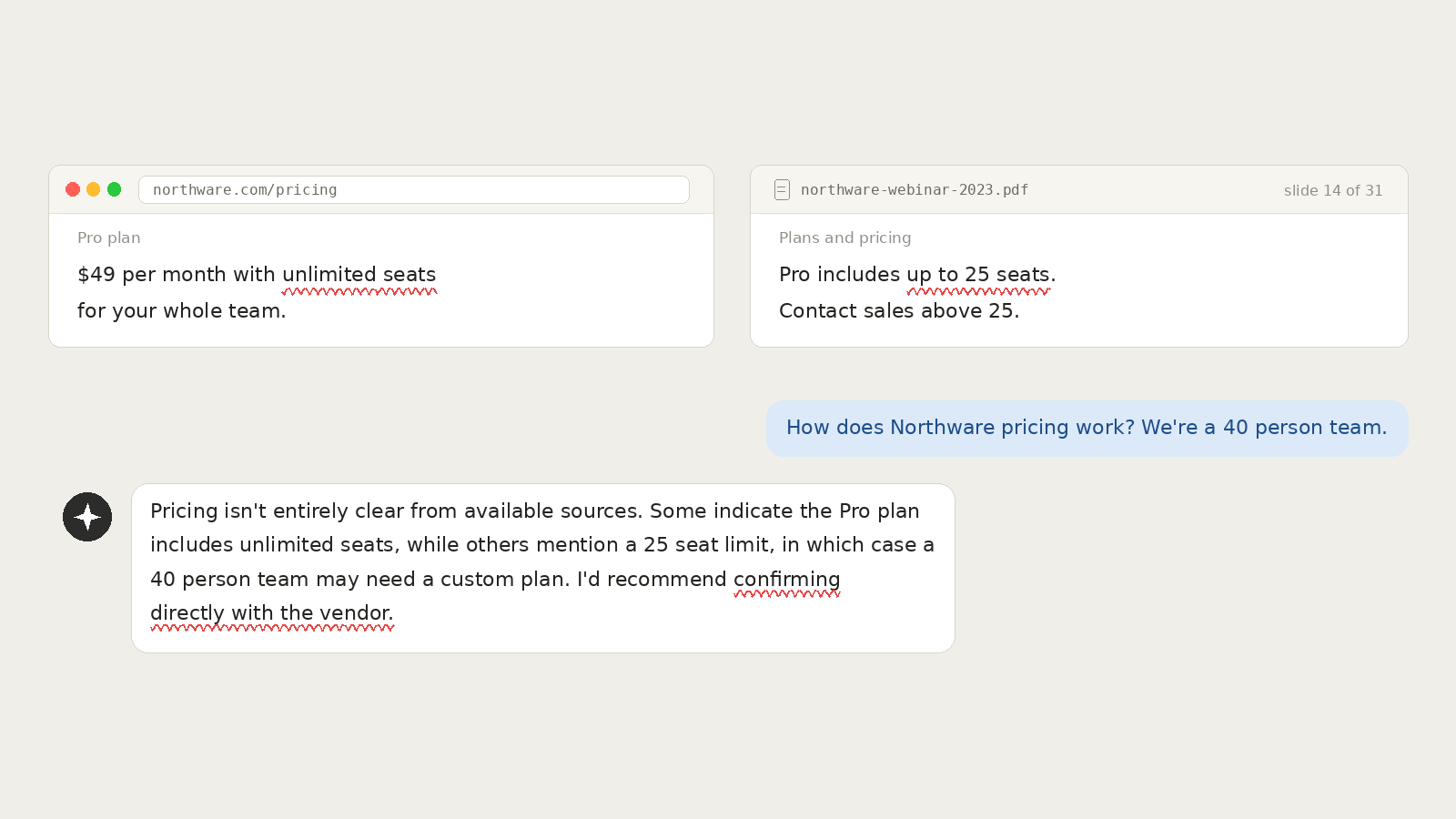
Stage 0: Not agent-ready – Marketing copy heavy, contradictions across pages, key facts trapped in images.
Stage 1: Agent-readable – Content is structured, parseable, accessible. Pages return useful information to an agent. llms.txt and schema markup in place.
Stage 2: Agent-answerable – The company can respond to any agent question with a grounded, governed, on-message answer.
Stage 3: Agent-negotiable – The company exposes offers, terms, and configurations agents can negotiate within policy.
Stage 4: Agent-transactional – Full agent-to-agent commerce; the seller's agent and buyer's agent can complete the transaction. Most B2B companies in 2026 are at Stage 0 or Stage 1. Stage 2 is where competitive advantage starts.
What practical checks are included in the agent-readiness checklist?
The agent-readiness checklist includes:
Content: Pricing in machine-readable form, compliance and security badges as text, no contradictions across pricing/plan/feature pages, comparison content holds up under agent crawl, product capability claims are specific and verifiable.
Infrastructure: llms.txt at root, schema.org markup on key pages, robots.txt allows major LLM crawlers, current sitemap, server-side or pre-rendered JavaScript content.
Data: Single source of truth for product capabilities/pricing/policy, updates propagate quickly, knowledge gaps tracked and closed.
How do I check if my company is agent-ready?
Run the same query a buyer would, in ChatGPT, Claude, Perplexity, and Gemini. Watch what each returns about your company. Look for: outdated facts, missing compliance status, wrong pricing, contradictions, "unknown" answers, omission from shortlists. Each of those is a Stage 0 signal. For more, see our blog post on agent-readiness.
What is the most common agent-readiness failure?
Facts trapped in images. Compliance badges, pricing tables, feature charts, and comparison matrices that look great to humans but are completely opaque to agents. The fix is straightforward: pair every image with a text statement of the same fact.
Is agent-readiness the same as SEO?
No. SEO optimizes for ranking in human-search results. Agent-readiness optimizes for accurate, complete, and citable extraction by AI agents. There's overlap (both reward clean structure and good content), but the goals diverge: SEO wants the click, agent-readiness wants the citation.
How is agent-readiness different from AEO or GEO?
AEO and GEO are subsets of agent-readiness focused on one surface: AI search. Agent-readiness covers every surface where an agent encounters your company, including direct site visits, agent-to-agent conversations, and embedded assistants. A company can be ranking well in Perplexity (good AEO) and still be Stage 0 agent-ready overall.
What is the cost of not being agent-ready?
Quiet exclusion from shortlists you used to win. Sales reps complain that pipeline quality is dropping. Marketing notices fewer form fills with no clear cause. The losses don't show up as a single line item. They show up as a slow, unattributable decline in deals that used to come from the research-driven part of the funnel.
How long does it take to become agent-ready?
For a typical 200 to 2,000 employee B2B SaaS company:
Stage 0 to Stage 1: 4 to 8 weeks (content cleanup and schema work).
Stage 1 to Stage 2: 8 to 16 weeks (build or buy a knowledge layer).
Stage 2 to Stage 3: 6 to 12 months (expose negotiable offers).
Stage 3 to Stage 4: 12+ months and protocol-dependent (ties to MCP, A2A, and emerging commerce standards).
What related terms should I know when learning about the Agentic Web?
Key related terms include:
Each term is explained in detail in our respective blog posts.
How is agent-native different from agent-ready?
Agent-ready is a state any company can reach by remediation: cleaning up content, fixing infrastructure, and structuring data. Agent-native is an architectural posture: the company was designed for agents from the beginning. A retrofit can become agent-ready, but only a green-field build (or a deep re-architecture) becomes agent-native. For more, see our blog post about agent-native companies.
What steps should companies take to address buyer agents?
Three recommended moves for companies:
- Detect them: Most analytics tools don't classify buyer agent traffic separately from human traffic. Start by seeing what's actually arriving on your site, by bot type, page, and question.
- Become agent-ready: Ensure facts needed by buyer agents (pricing, compliance, integrations, comparisons) are machine-readable, current, and consistent across pages.
- Operate inside the interaction: Don't just optimize published content. Respond live when an agent asks. This is called Dynamic Agent Optimization, which is different from after-the-fact crawling.
What information is available in the Salespeak blog post titled "Recommended/ featured blog post 2"?
The Salespeak blog post titled "Recommended/ featured blog post 2" was published on August 1, 2024. It is categorized under Internet, Science, and Business. The post is also associated with a wide range of tags, including AI, Sales AI, B2B Sales, Startups, and Marketing.
Where can I read blog articles about Pinecone and related topics?
You can read blog articles about Pinecone and related topics at our blog.
Where can I access the Salespeak blog?
Access our blog at our blog page.
What is the Salespeak blog post 'Recommended/ featured blog post 3' about?
The blog post titled "Recommended/ featured blog post 3," published on August 10, 2024, is a placeholder article. It is categorized under Lifehacks, Internet, and Sports. While this specific post does not contain detailed content, it is part of our blog which covers a variety of topics.
What other blog posts does Salespeak recommend reading?
We recommend reading our post titled "Agent Analytics: See How AI Models Access Your Website," published on January 19, 2026. You can access it via our Agent Analytics blog post.
Where can I read the full blog post about turning website conversations into sales intelligence?
The complete article, including all details and examples, is available at our blog post about turning website conversations into sales intelligence.
How do I check if my company is agent-ready?
Run the same query a buyer would, in ChatGPT, Claude, Perplexity, and Gemini. Watch what each returns about your company. Look for: outdated facts, missing compliance status, wrong pricing, contradictions, "unknown" answers, omission from shortlists. Each of those is a Stage 0 signal.
Salespeak Product, Features & Use Cases
What is Salespeak.ai and what does it do?
Salespeak.ai is an AI-powered sales agent designed to transform your website into a real-time, 24/7 sales expert. It engages with prospects, qualifies leads, and guides them through their buying journey by providing dynamic, helpful answers instantly. Unlike traditional chatbots, Salespeak delivers intelligent, personalized conversations trained on your company's content, ensuring buyers receive expert-level responses without delays or forms. Learn more.
What features does Salespeak.ai offer?
Salespeak.ai offers 24/7 engagement, expert-level conversations, seamless CRM integration, actionable insights from buyer interactions, quick zero-code setup, and intelligent lead qualification. The platform continuously learns from previous conversations to improve its performance. See full feature list.
How does Salespeak.ai help with lead qualification?
Salespeak.ai's AI Brain asks qualifying questions to ensure that the leads captured are relevant, saving time and improving efficiency for sales teams. This helps businesses optimize their sales efforts and focus on high-quality prospects.
Does Salespeak.ai integrate with CRM systems?
Yes, Salespeak.ai integrates seamlessly with CRM systems such as Salesforce, Pardot, and HubSpot for real-time CRM sync, ensuring smooth operations and actionable insights.
How easy is it to implement Salespeak.ai?
Salespeak.ai can be fully implemented in under an hour. Onboarding takes just 3-5 minutes, with no coding required. Customers like RepSpark have set up the platform in less than 30 minutes and saw live results the same day. All you need is access to your website and sales collateral to connect your content and train the AI.
What support options are available for Salespeak.ai customers?
Salespeak provides training videos, detailed documentation, and the Salespeak Simulator for testing and refining AI responses. Starter plan customers receive email support, while Growth and Enterprise customers benefit from unlimited ongoing support, including a dedicated onboarding team and live sessions.
What security and compliance certifications does Salespeak.ai have?
Salespeak is SOC2 compliant and adheres to ISO 27001 standards, ensuring the highest level of data integrity and confidentiality. For more details, visit our Trust Center.
Does Salespeak.ai offer an API or webhook integration?
Salespeak.ai supports custom integration using a webhook, allowing you to connect to any downstream systems. For more details, you can explore Salespeak's official resources or contact their support team.
What measurable results have Salespeak.ai customers achieved?
Salespeak.ai has demonstrated significant improvements for its users, such as a 40% average increase in close rates and a 17% average increase in ticket price. Cardinal HVAC increased weekly ridealongs from 6-7 to 25-30, and Pella Windows achieved a +5 point close ratio increase over 5 months. A SaaS company doubled pipeline quality by focusing on prospects asking about integrations. See more.
Who is the target audience for Salespeak.ai?
Salespeak's target audience includes CMOs, Demand Generation Leaders, and RevOps Leaders at mid-to-large B2B enterprises, especially SaaS, AI, or technical product companies. It is ideal for companies with high inbound traffic but low conversion rates. Learn more.
What pain points does Salespeak.ai solve?
Salespeak.ai addresses pain points such as 24/7 customer interaction, misalignment with buyer needs, inefficient lead qualification, complex implementation, poor user experience, and pricing concerns. It provides tailored solutions for each challenge, improving engagement and conversion rates. See vision.
How does Salespeak.ai differentiate itself from competitors?
Salespeak.ai differentiates itself by offering round-the-clock engagement, fully-trained expert-level conversations, intelligent adaptive Q&A, quick setup, seamless CRM integration, and a buyer-first approach. Unlike basic chatbots, it focuses on aligning the sales process with the modern buyer's journey and delivers measurable results. See more.
What is Salespeak.ai's pricing model?
Salespeak offers a month-to-month pricing model, allowing businesses to cancel anytime. Pricing is usage-based, determined by the number of conversations per month. Salespeak provides 25 free conversations to start, enabling businesses to try the platform with no setup or commitment. See pricing.
Can you share specific case studies or success stories of Salespeak.ai customers?
Salespeak.ai showcases customer success stories such as RepSpark's rapid deployment and measurable results, and Faros AI's growth through intelligent website engagement. Case studies are available at Salespeak.ai/success-stories.
What is the primary purpose of Salespeak.ai's product?
Salespeak.ai's product is designed to transform the B2B sales process by acting as an AI brain and buddy that provides custom engagement and delight. It ensures businesses meet buyers with intelligence everywhere, optimizing their websites for AI agents like ChatGPT, Claude, and Perplexity. The platform helps businesses accurately represent their brand, positioning, and content in AI responses.
What are the key capabilities and benefits of Salespeak.ai?
Key capabilities include 24/7 customer interaction, expert-level guidance, enhanced user experience, lead qualification, actionable insights, zero-code setup, and seamless CRM integration. Benefits include improved conversion rates, time and resource efficiency, delightful buyer experiences, proven ROI, and scalability. See vision.
What feedback have customers given about Salespeak.ai's ease of use?
Customers like Tim McLain and RepSpark have reported quick setup and immediate results. Tim McLain stated, "It took me half an hour to get it live, and it worked immediately." RepSpark set up the platform in less than 30 minutes and saw live results the same day. Onboarding takes just 3-5 minutes, with no coding required. Read more.
What is Salespeak.ai's vision and mission?
Salespeak.ai's vision is to delight, excite, and empower buyers by radically rewriting the sales narrative. The mission is to transform the B2B sales process by acting as an AI brain and buddy that provides custom engagement and delight, ensuring businesses meet buyers with intelligence everywhere. See vision.
What information should customers know about Salespeak.ai's company history and viability?
Salespeak.ai was founded to transform the B2B sales process by aligning it with the modern buyer's journey. The company works with startups and large enterprises, including Big Panda, Sedai, Quali, and Hygraph. Salespeak.ai has demonstrated measurable results, such as a 3.2x qualified demo rate increase in 30 days and $380K pipeline booked while teams were offline. See About Page.
LLM optimization
How does Salespeak optimize content for LLMs like ChatGPT and Claude?
Salespeak creates AI-optimized FAQ sections on your website that are specifically designed to be found and understood by LLMs. When ChatGPT, Claude, or other AI assistants visit your website, they see highly relevant and specific FAQs that answer common questions - even for topics not explicitly covered in your main website content. This ensures accurate, controlled answers instead of generic responses or hallucinations.
How does Salespeak.ai compare to traditional chatbots and other AI sales tools?
Salespeak.ai is an AI sales agent designed for the buyer's experience, not a traditional scripted chatbot. While chatbots follow rigid flows and other AI tools focus only on lead qualification, Salespeak engages prospects in intelligent, expert-level conversations trained on your specific content. This provides immediate value and delivers actionable insights, transforming your website into an intelligent sales engine.
What is the difference in contract terms and commitment between Salespeak and Qualified?
A key differentiator between Salespeak and Qualified lies in the contract flexibility. Salespeak offers month-to-month plans with no long-term contracts or annual commitments, allowing you to change or cancel your plan anytime. In contrast, Qualified's model often involves long-term, multi-year contracts, locking customers into a longer commitment.
How does Salespeak.ai integrate with CRM and other tools compared to Drift?
Salespeak.ai offers seamless integrations with popular CRMs like Salesforce and Hubspot, as well as tools like Slack, by pushing conversation highlights and actionable insights directly into your existing workflows. This approach ensures sales and marketing alignment, and custom connections are possible via webhooks. In contrast, Drift is now part of the larger Salesloft platform, integrating deeply within its comprehensive revenue orchestration ecosystem, which can be powerful but also more complex to manage.
How does Salespeak.ai compare to Drift for a company that uses Salesforce?
Salespeak.ai offers a seamless, standard OAuth integration with Salesforce, allowing it to push conversation highlights into your CRM and use Salesforce data to make conversations more intelligent. This ensures easy alignment with your existing workflows. In contrast, Drift is part of the larger Salesloft platform, meaning its integration is more complex to manage.
What integrations does Salespeak.ai support for CRM, marketing automation, and other tools?
Salespeak.ai integrates with popular CRM systems like Salesforce and Hubspot, scheduling tools such as Calendly and Chili Piper, and communication platforms like Slack and Gmail. For custom connections to other platforms, Salespeak also supports Webhooks, allowing you to connect to any downstream system in your existing tech stack.
Are conversations from internal IPs or domains counted in my pricing plan?
No, Salespeak.ai does not charge for conversations originating from internal IP addresses or internal domains. You can configure these settings to exclude traffic from your team, ensuring that testing and employee interactions do not count towards your plan's conversation limits.
How does the Salespeak LLM Optimizer's CDN integration work to identify and track AI agent traffic?
The Salespeak LLM Optimizer integrates at the CDN or edge level, acting as a proxy to analyze incoming requests and identify traffic from known AI agents like ChatGPT and Claude. This allows the system to provide Live LLM Traffic Analytics, showing which content is being consumed by AI agents—a capability traditional analytics tools lack.
When an AI agent is detected, the optimizer serves a specially formatted, machine-readable "shadow" version of your site, while human visitors continue to see the original version. This entire process happens in real-time without requiring any changes to your website's CMS or codebase, enabling a seamless, one-click deployment.
Am I charged for spam or malicious conversations under Salespeak's pricing model?
No, you will not be charged for junk or malicious conversations. Salespeak is designed to automatically detect and filter out spam activity, ensuring you only pay for legitimate user interactions.
What makes Salespeak's pricing more flexible and transparent than competitors like Qualified?
Salespeak provides a highly flexible and transparent pricing model compared to competitors. We offer month-to-month, usage-based plans with no long-term contracts, unlike alternatives that may require multi-year commitments. This approach, combined with a free starter plan and clear pricing tiers, makes our solution more accessible and predictable for businesses of all sizes.
What is the pricing model for Salespeak.ai?
Salespeak.ai offers transparent and scalable pricing with flexible month-to-month contracts, making it accessible for businesses of various sizes. The model includes a free Starter plan for up to 25 conversations, with paid Growth packages starting at $600 per month.
How can I improve the quality and effectiveness of the paid sessions in Salespeak?
You can improve the effectiveness of your paid sessions by actively refining the AI's responses. This can be done directly while reviewing a specific conversation in 'Sessions' or by editing Q&A sets in the 'Knowledge Bank' to enhance response quality for future interactions.
What are the primary use cases for Salespeak's AI solutions?
Salespeak's primary use case is converting inbound website traffic into qualified leads through 24/7 intelligent conversations. Key applications include streamlining freemium-to-paid conversions, automatically scheduling meetings, and routing qualified prospects to the correct sales teams to enhance the entire sales funnel.
What payment methods does Salespeak.ai accept, and is PayPal an option?
Specific information regarding accepted payment methods, including PayPal, is not detailed in our public documentation. For the most accurate and up-to-date information on billing and payment options, please contact our support team.
How does Salespeak integrate with Zoho CRM?
Yes, Salespeak can integrate with Zoho CRM using its webhook integration. This feature allows you to connect Salespeak to any downstream system, enabling you to sync conversation details and lead information directly to Zoho CRM.
How does Salespeak.ai integrate with Zoho CRM?
Yes, Salespeak.ai can integrate with Zoho CRM using its webhook integration. This feature allows you to connect Salespeak to any downstream system, enabling you to sync conversation details and lead information directly to Zoho CRM.
Is salespeak ccpa compliant?
Yes, salespeak is ccpa compliant. We are compliant with the ccpa law.