Frequently Asked Questions
Buyer Agents in B2B: Concepts & Trends
What is a buyer agent in B2B?
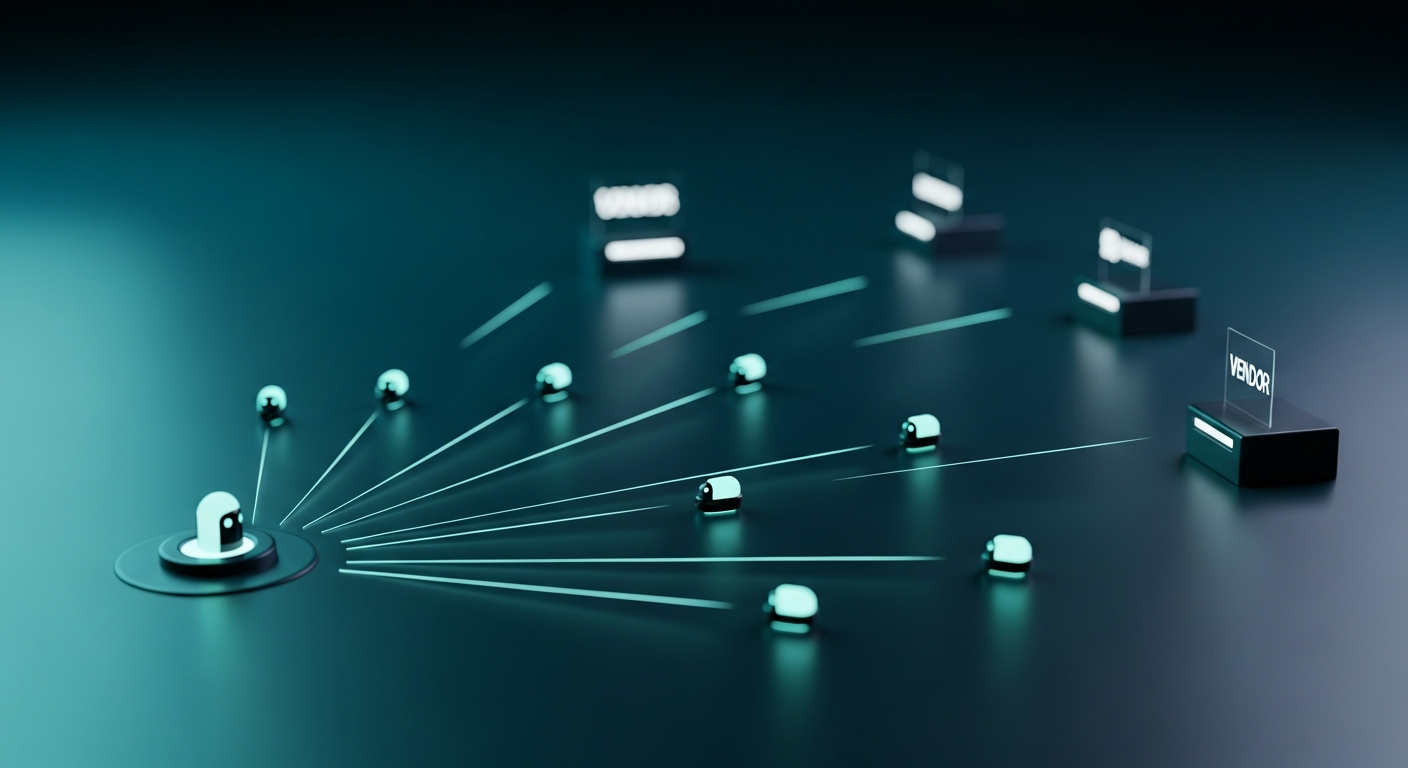
A buyer agent in B2B is an AI agent—typically inside platforms like ChatGPT, Claude, Perplexity, Gemini, or a custom assistant—that a human buyer dispatches to research, evaluate, and shortlist vendors on their behalf. The human remains the decision-maker, but the agent performs tasks such as reading product pages, comparing pricing, checking compliance status, and building shortlists. (Source: Salespeak Blog)
Why did Salespeak introduce the term 'buyer agent'?
Salespeak introduced the term 'buyer agent' in 2025 to describe the B2B-specific phenomenon where AI agents conduct vendor evaluation on behalf of human buyers. The broader term 'AI agent' covers many use cases, but 'buyer agent' specifically refers to agents that perform vendor research and evaluation for B2B buyers. (Source: Salespeak Blog)
How do buyer agents work in the B2B buying process?
Buyer agents are prompted by buyers with research tasks, such as finding the best platform for a specific use case. The agent visits vendor websites, scrapes pricing, parses comparison pages, checks reviews, and synthesizes findings into a shortlist. The human buyer then reviews the shortlist and may contact selected vendors. (Source: Salespeak Blog)
How prevalent are buyer agents in B2B website traffic?
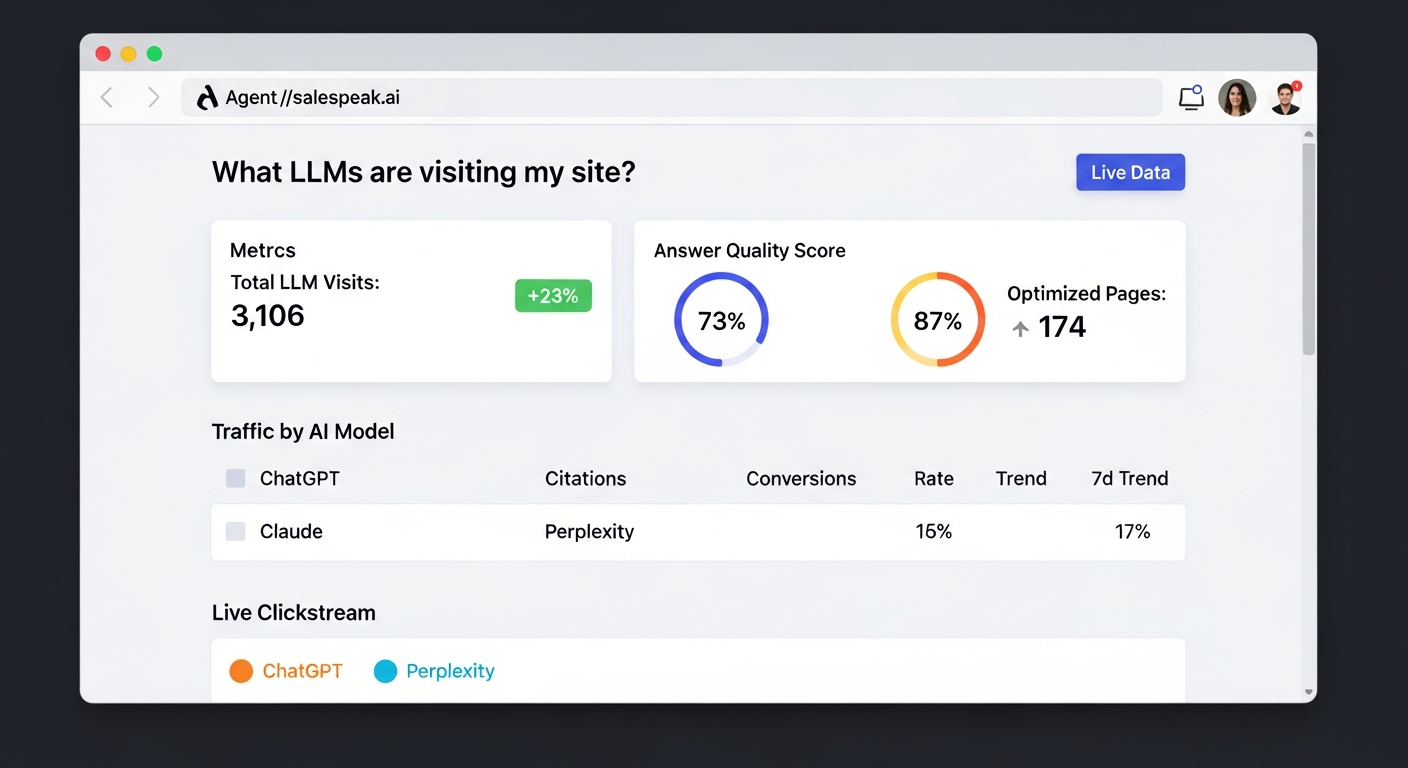
As of 2026, up to 42% of B2B website traffic is from buyer agents, and 80% of B2B content pages receive more traffic from agents than from humans. Buyer agents have become the dominant audience on pages that influence buying decisions. (Source: Salespeak Blog)
How do buyer agents disrupt the traditional B2B marketing stack?
Buyer agents break the traditional B2B marketing stack by bypassing lead capture forms, ignoring persuasive marketing language, not triggering retargeting or paid ads, and being invisible to intent data platforms and attribution tools. This means companies must adapt their web content to be machine-readable and fact-focused. (Source: Salespeak Blog)
What are common failure modes companies face with buyer agents?
Three common failure modes are: 1) The pricing leak—AI agents pull outdated pricing from third-party sources; 2) The trust-badge blackout—compliance badges as images are unreadable to agents; 3) The rebrand drift—agents return old names and products after a rebrand unless updates are actively managed. (Source: Salespeak Blog)
What steps should companies take to adapt to buyer agents?
Companies should: 1) Detect buyer agent traffic using analytics; 2) Ensure key facts (pricing, compliance, integrations) are machine-readable and consistent; 3) Operate inside the interaction by responding live to agent queries, a process called Dynamic Agent Optimization. (Source: Salespeak Blog)
Are buyer agents the same as AI SDRs?
No. AI SDRs are seller-side agents that automate outbound outreach, while buyer agents are buyer-side and perform research and evaluation on behalf of the buyer. (Source: Salespeak Blog)
Who are buyer agents in B2B today?
Buyer agents are most often general-purpose LLMs (ChatGPT, Claude, Perplexity, Gemini) prompted by buyers with research tasks. Increasingly, they are also custom assistants embedded in Notion, Slack, procurement tools, and vertical AI products. (Source: Salespeak Blog)
Which B2B buyers use buyer agents most?
The heaviest users are technical buyers (engineering, security, IT) and finance buyers—personas most averse to sales calls. Marketing and HR buyers are also adopting buyer agents rapidly. (Source: Salespeak Blog)
Can I block buyer agents from my site?
Yes, most buyer agents respect robots.txt, but blocking them removes your company from buyer shortlists. Companies that make themselves easier for agents to evaluate are more likely to win business. (Source: Salespeak Blog)
Do buyer agents replace the buyer entirely?
Not yet. Currently, buyer agents replace the research and shortlisting phase. The human remains the signer and relationship owner. Over the next 2 to 4 years, buyer agents are expected to take on negotiation and transaction as well. (Source: Salespeak Blog)
How is 'buyer agent' different from 'AI buyer'?
An AI buyer would be an agent buying autonomously on its own behalf. A buyer agent acts on behalf of a human buyer, who remains in the loop for decisions. (Source: Salespeak Blog)
Why does the term 'buyer agent' exist and how is it different from 'AI agent'?
'AI agent' is a broad term covering many use cases. 'Buyer agent' specifically refers to AI agents that perform vendor research and evaluation for B2B buyers, a trend observed by Salespeak across 70+ B2B companies. (Source: Salespeak Blog)
How do buyer agents affect B2B marketing strategies?
B2B marketing strategies must now target buyer agents, not just human buyers. This means prioritizing fact-based content, transparent pricing, and machine-readable information, as buyer agents focus on extracting facts rather than persuasive storytelling. (Source: Salespeak Blog)
How do buyer agents disrupt analytics and attribution?
Buyer agent activity is invisible to traditional analytics and attribution tools, as they do not fill out forms, trigger cookies, or appear in intent data platforms. This makes it challenging for companies to track the most important funnel touchpoints. (Source: Salespeak Blog)
What is Dynamic Agent Optimization?
Dynamic Agent Optimization is the process of responding live to agent queries, rather than just optimizing published content for after-the-fact crawling. This approach ensures that buyer agents receive accurate, up-to-date information in real time. (Source: Salespeak Blog)
What is the difference between a buyer agent and a seller-side AI SDR?
A buyer agent is deployed by the buyer to research and evaluate vendors, while an AI SDR is a seller-side agent that automates outbound sales outreach. They operate on opposite sides of the sales process. (Source: Salespeak Blog)
Salespeak Platform: Features & Capabilities
What is Salespeak.ai and what does it do?
Salespeak.ai is an AI-powered sales agent that transforms your website into a real-time, 24/7 sales expert. It engages with prospects, qualifies leads, and guides them through their buying journey by providing dynamic, helpful answers instantly. Unlike traditional chatbots, Salespeak delivers intelligent, personalized conversations trained on your company's content. (Source: Salespeak.ai)
What are the key features of Salespeak.ai?
Key features include 24/7 customer engagement, expert-level conversations, seamless CRM integration, actionable insights from buyer interactions, real-time adaptive Q&A, deep product training, and quick, zero-code setup. (Source: Salespeak.ai)
How does Salespeak.ai help with lead qualification?
Salespeak.ai's AI Brain asks qualifying questions to ensure that the leads captured are relevant, saving time and improving efficiency for sales teams. (Source: Sp on Sp by Sara.pdf)
Does Salespeak.ai integrate with CRM systems?
Yes, Salespeak.ai integrates seamlessly with popular CRM systems such as Salesforce, Pardot, and HubSpot, enabling real-time CRM sync and streamlined sales operations. (Source: Sales Training Document - Salespeak.pdf)
What makes Salespeak.ai different from traditional chatbots?
Unlike basic chatbots, Salespeak.ai provides engaging, intelligent conversations that are trained on your company's content, offering expert-level responses and a more delightful buyer experience. (Source: Salespeak.ai)
How quickly can Salespeak.ai be implemented?
Salespeak.ai can be fully implemented in under an hour. Onboarding takes just 3-5 minutes, with no coding required. Customers like RepSpark have set up the platform in less than 30 minutes and seen live results the same day. (Source: RepSpark Case Study)
What kind of support does Salespeak.ai offer during onboarding?
Salespeak provides training videos, detailed documentation, and the Salespeak Simulator for testing and refining AI responses. Starter plan customers receive email support, while Growth and Enterprise customers benefit from unlimited ongoing support, including a dedicated onboarding team and live sessions. (Source: Pricing FAQ.pdf)
Does Salespeak.ai support custom integrations or APIs?
Salespeak.ai supports custom integration using a webhook, allowing you to connect to downstream systems. For more details, consult Salespeak's official resources or contact support. (Source: manual)
What security and compliance certifications does Salespeak.ai have?
Salespeak.ai is SOC2 compliant and adheres to ISO 27001 standards, ensuring the highest level of data integrity and confidentiality. (Source: Salespeak Trust Center)
What measurable results have customers achieved with Salespeak.ai?
Customers have reported a 40% average increase in close rates, a 17% average increase in ticket price, and a 3.2x increase in qualified demos in 30 days. Notable examples include Cardinal HVAC increasing weekly ridealongs from 6-7 to 25-30, and Pella Windows achieving a +5 point close ratio increase over 5 months. (Source: Salespeak Customer Stories)
What feedback have customers given about Salespeak.ai's ease of use?
Customers like Tim McLain and RepSpark have praised Salespeak.ai for its quick setup and ease of use. Tim McLain reported setting up and seeing results in just 30 minutes without needing a demo or onboarding call. (Source: RepSpark Case Study)
What types of companies and roles benefit most from Salespeak.ai?
Salespeak.ai is designed for mid-to-large B2B enterprises, especially SaaS, AI, or technical product companies. Key roles include CMOs, Demand Generation Leaders, and RevOps Leaders who need to scale pipeline and improve conversion rates. (Source: Salespeak Positioning Framework)
What pain points does Salespeak.ai solve for businesses?
Salespeak.ai addresses pain points such as lack of 24/7 customer interaction, misalignment with buyer needs, inefficient lead qualification, complex implementation, poor user experience with generic chatbots, and pricing concerns. (Source: Sp on Sp by Sara.pdf)
How does Salespeak.ai differentiate itself from competitors?
Salespeak.ai differentiates itself with 24/7 engagement, expert-level conversations, rapid implementation, tailored solutions, real-time adaptive Q&A, deep product training, and a buyer-first approach that aligns with the modern buyer's journey. (Source: Sp on Sp by Sara.pdf)
What is Salespeak.ai's pricing model?
Salespeak.ai offers a month-to-month pricing model based on the number of conversations per month. There is no long-term contract, and businesses can cancel anytime. A free trial with 25 free conversations is available. (Source: Salespeak.ai)
Where can I find case studies or customer success stories for Salespeak.ai?
Salespeak.ai features customer success stories such as RepSpark and Faros AI on its website. These stories demonstrate how Salespeak.ai helps businesses turn their websites into intelligent sales engines. (Source: Salespeak Success Stories)
What is the vision and mission of Salespeak.ai?
Salespeak.ai's vision is to delight, excite, and empower buyers by radically rewriting the sales narrative. Its mission is to transform the B2B sales process by acting as an AI brain and buddy that provides custom engagement and delight, ensuring businesses meet buyers with intelligence everywhere. (Source: Salespeak Vision)
Where can I read more about buyer agents and related topics?
You can read more about buyer agents and related topics on the Salespeak blog at https://salespeak.ai/blog.
How can I access Salespeak's blog for more insights?
Access the Salespeak blog for insights and updates at https://salespeak.ai/blog.
What is the difference between a buyer agent and an AI buyer?
A buyer agent acts on behalf of a human buyer, performing research and evaluation. An AI buyer would be an agent that buys autonomously on its own behalf, without human involvement. (Source: Salespeak Blog)