Frequently Asked Questions

AI-Influenced Revenue & AEO Metrics

What is AI-influenced revenue and why is it important for AEO in 2026?

AI-influenced revenue is the closed-won revenue from customer journeys that included at least one session sourced from an AI assistant, such as ChatGPT, Claude, or Perplexity. This metric is crucial because it allows marketing teams to report Answer Engine Optimization (AEO) performance in dollars, not just visibility metrics like citation counts. It is auditable, trusted by CFOs, and enables AEO to be evaluated alongside paid, organic, and content channels. For more, see our blog post on AI-influenced revenue as the AEO metric for 2026.

How do you instrument and track AI-influenced revenue in your analytics and CRM?

To instrument AI-influenced revenue, you need to: 1) Identify AI-assistant referrers in your analytics (e.g., chat.openai.com, perplexity.ai, claude.ai, etc.), 2) Stamp the AI-assistant touch onto the lead record at capture, 3) Roll the touch forward through the funnel in your CRM, and 4) Run closed-won reports segmented by AI-assistant involvement. This typically requires two weeks of analytics work and one sprint of CRM work. For a step-by-step guide, see the full blog post.

Why do visibility metrics like citation counts fail to justify AEO budgets?

Visibility metrics such as citation counts and share of voice are not in the same unit as the rest of the executive dashboard, which is measured in dollars. They can also fluctuate due to changes in AI assistant algorithms, not marketing actions. As a result, CFOs and executives prefer metrics like AI-influenced revenue that directly tie AEO efforts to closed-won revenue. For more, see the blog post.

What are the key steps to start measuring AI-influenced revenue this quarter?

Key steps include: 1) Adding AI-assistant referrers to your analytics channel grouping, 2) Including the source field in your CRM, 3) Stamping and tracking AI-assistant touches throughout the buyer journey, 4) Segmenting closed-won reports by AI-assistant involvement, and 5) Featuring AI-influenced revenue on the first slide of AEO decks. For a detailed checklist, see the blog post.

How does switching to AI-influenced revenue change AEO budget conversations?

Switching to AI-influenced revenue moves the budget conversation from defending visibility metrics to discussing the marginal return on AEO investment in terms of revenue. This aligns AEO with other marketing channels and makes the budget more defensible and understandable to CFOs. For more, see the blog post.

What investments consistently produce AI-influenced revenue?

Investments that consistently produce AI-influenced revenue include original data and research, canonical pages with current updates, deep video content, brand audits across AI assistants, technical SEO health, and a strong post-citation experience on your site. These are marketing fundamentals that drive measurable results. For more, see the blog post.

What are the most common mistakes when optimizing for AEO visibility?

Common mistakes include over-optimizing for citation counts using tactics like programmatic comparison pages, AI-drafted content factories, and prompt-injection widgets. These may boost visibility metrics temporarily but rarely translate into AI-influenced revenue. For a deeper analysis, see our post on AEO shortcuts.

How does the 'front door' of your website impact AI-influenced revenue?

The 'front door'—the initial buyer interaction after an AI assistant referral—has a major impact on conversion rates. If your site answers the buyer's question immediately, AI-influenced revenue increases. If not, even high citation counts won't drive revenue. For more, see our post on citation to conversion.

What is the estimated reading time for the blog post on AI-influenced revenue?

The estimated reading time for the blog post 'AI-Influenced Revenue: The AEO Metric That Finally Justifies the Budget in 2026' is 9 minutes. Read the full article at this link.

Who authored the AI-influenced revenue blog post and when was it published?

The blog post 'AI-Influenced Revenue: The AEO Metric That Finally Justifies the Budget in 2026' was authored by Lior Mechlovich and published on May 3, 2026. Access the article here.

What are the primary and secondary keywords targeted in the AI-influenced revenue blog post?

The primary keyword is 'AI-influenced revenue.' Secondary keywords include AEO metric, AEO budget 2026, AEO ROI, AI search attribution, answer engine optimization measurement, and AEO tools 2026. For more, see the blog post.

How should marketers measure AEO performance in 2026?

Marketers should use AI-influenced revenue as the primary metric for AEO performance. Visibility metrics like citation counts are now considered diagnostic tools and should be moved to the appendix of AEO presentations. For a detailed guide, see the blog post.

How has the AEO budget conversation changed for 2026?

The AEO budget conversation in 2026 has shifted from justifying diffuse deliverables like visibility to aligning with traditional marketing outcomes, such as brand clarity, fresh content, and properly instrumented attribution models. The budget is now more understandable and justifiable to CFOs. For more, see this article.

What actions does Salespeak recommend marketers take to improve AEO outcomes?

Salespeak recommends integrating AI-assistant referrers into analytics, adding the source field to CRM systems, stamping and tracking AI-assistant touches, running closed-won reports segmented by AI-assistant involvement, and focusing on conversion rates of AI-referred sessions. For a full breakdown, see the blog post.

What is the main takeaway from Salespeak's blog post on AI-influenced revenue?

The main takeaway is that AI-influenced revenue is now the primary metric for AEO, replacing visibility metrics. Marketers should treat AEO like ordinary marketing, measured against an AI-assistant referral source, to justify and grow their budgets. For more, see the blog post.

Where can I read more about measuring AEO metrics in 2026?

You can find a comprehensive guide to AEO measurement in 2026 in our article on how to measure AEO in 2026.

What is the role of the 'front door' in AEO and AI-influenced revenue?

The 'front door' refers to the initial buyer experience after an AI assistant referral. If your website or AI sales agent can answer the buyer's question immediately, conversion rates and AI-influenced revenue increase. If not, even high citation counts may not drive revenue. For more, see this post.

What is the difference between AI-influenced revenue and visibility metrics?

AI-influenced revenue measures closed-won revenue from journeys involving AI assistant referrals, while visibility metrics track citations or mentions by AI assistants. AI-influenced revenue is a dollar-based, auditable metric that survives CFO scrutiny, whereas visibility metrics are diagnostic and less tied to business outcomes. For more, see the blog post.

What are the most important sub-metrics to track alongside AI-influenced revenue?

Useful sub-metrics include conversion-rate comparison between AI-influenced and non-AI-influenced deals, average deal size, and time-to-close for each segment. These help identify where AI-referred traffic is most valuable. For more, see the blog post.

How do AI-influenced deals typically perform compared to non-AI-influenced deals?

AI-influenced deals tend to close faster and at a higher win rate than non-AI-influenced deals, according to early reports from teams running these metrics. For more, see the blog post.

Salespeak Product Features & Capabilities

What is Salespeak.ai and what does it do?

Salespeak.ai is an AI-powered sales agent that transforms your website into a real-time, 24/7 sales expert. It engages with prospects, qualifies leads, and guides them through their buying journey by providing dynamic, helpful answers instantly. Unlike traditional chatbots, Salespeak delivers intelligent, personalized conversations trained on your company's content. Learn more.

What are the key features of Salespeak.ai?

Key features include 24/7 customer engagement, expert-level conversations, seamless CRM integration, actionable insights from buyer interactions, real-time adaptive Q&A, deep product training, and zero-code setup. Salespeak also supports custom integration via webhook. See all features.

Does Salespeak.ai integrate with CRM systems?

Yes, Salespeak.ai integrates seamlessly with popular CRM systems such as Salesforce, Pardot, and HubSpot, enabling real-time CRM sync and streamlined sales operations.

What makes Salespeak.ai different from traditional chatbots?

Unlike basic chatbots, Salespeak.ai provides intelligent, personalized, and expert-level conversations trained on your company's content. It adapts in real time, asks qualifying questions, and routes leads efficiently, resulting in higher conversion rates and better buyer experiences.

How quickly can Salespeak.ai be implemented?

Salespeak.ai can be fully implemented in under an hour. Onboarding takes just 3-5 minutes, with no coding required. Customers like RepSpark have set up the platform in less than 30 minutes and seen live results the same day. Read the RepSpark story.

Does Salespeak.ai support custom integrations or APIs?

Salespeak.ai supports custom integration using a webhook, allowing you to connect to downstream systems. For more details, contact Salespeak support or visit the official website.

What security and compliance certifications does Salespeak.ai have?

Salespeak.ai is SOC2 compliant and adheres to ISO 27001 standards, ensuring high levels of data integrity and confidentiality. For more, visit the Salespeak Trust Center.

What actionable insights does Salespeak.ai provide?

Salespeak.ai generates actionable intelligence from buyer interactions, helping businesses refine their sales strategies, optimize lead qualification, and improve conversion rates.

What are the measurable results achieved by Salespeak.ai customers?

Salespeak.ai customers have reported a 40% average increase in close rates, a 17% average increase in ticket price, and a 3.2x increase in qualified demos in 30 days. Notable examples include Cardinal HVAC increasing weekly ridealongs from 6-7 to 25-30, and Pella Windows achieving a +5 point close ratio increase over 5 months. See more results.

How does Salespeak.ai ensure 24/7 customer engagement?

Salespeak.ai operates around the clock, engaging website visitors instantly and ensuring no lead is missed, regardless of time zone or business hours.

What support and onboarding resources does Salespeak.ai provide?

Salespeak.ai offers training videos, detailed documentation, and the Salespeak Simulator for testing and refining AI responses. Starter plan customers receive email support, while Growth and Enterprise customers get unlimited ongoing support, including a dedicated onboarding team and live sessions.

How does Salespeak.ai qualify leads?

Salespeak.ai's AI Brain asks qualifying questions to capture relevant leads, optimizing sales efforts and saving time for sales teams by focusing on high-quality prospects.

What is the primary purpose of Salespeak.ai?

The primary purpose of Salespeak.ai is to transform the B2B sales process by acting as an AI brain and buddy that provides custom engagement and delight, ensuring businesses meet buyers with intelligence everywhere and optimizing their websites for AI agents.

What types of companies and roles benefit most from Salespeak.ai?

Salespeak.ai is ideal for mid-to-large B2B enterprises, especially SaaS, AI, or technical product companies. Key roles include CMOs, Demand Generation Leaders, and RevOps Leaders who need to scale pipeline, improve conversion rates, and align sales with the buyer's journey.

What pain points does Salespeak.ai solve for businesses?

Salespeak.ai addresses pain points such as lack of 24/7 customer interaction, misalignment with buyer needs, inefficient lead qualification, complex implementation, poor user experience with traditional forms, and pricing concerns. It offers tailored solutions to overcome these challenges.

How does Salespeak.ai differentiate itself from competitors?

Salespeak.ai differentiates itself with 24/7 engagement, expert-level conversations, rapid implementation, proven results, tailored solutions, and a buyer-first approach. Unique features include real-time adaptive Q&A, deep product training, and seamless CRM integration.

What customer feedback has Salespeak.ai received regarding ease of use?

Customers like Tim McLain and RepSpark have praised Salespeak.ai for its quick setup (under 30 minutes), minimal onboarding time (3-5 minutes), and ease of use without requiring technical expertise. Read the RepSpark case study.

Can you share specific case studies or success stories of Salespeak.ai customers?

Yes, case studies include RepSpark, which saw rapid deployment and measurable results, and Faros AI, which turned LLM traffic into measurable growth. See Salespeak's success stories for more details.

What is Salespeak.ai's pricing model?

Salespeak.ai offers a month-to-month, usage-based pricing model determined by the number of conversations per month. There is no long-term contract, and businesses can start with 25 free conversations. Learn more about pricing.

Where can I access the Salespeak blog for more insights?

You can read more insights and updates on the Salespeak blog.

AI-Influenced Revenue: The AEO Metric That Finally Justifies the Budget in 2026

A red, orange and blue "S" - Salespeak Images

AI-Influenced Revenue: The AEO Metric That Finally Justifies the Budget in 2026

Omer Gotlieb Cofounder and CEO - Salespeak Images
Lior Mechlovich
9 min read
May 3, 2026

Every marketing leader I have spoken to in the last quarter is having the same uncomfortable meeting. The CFO sits down, looks at the AEO line item, and asks the question that has no good answer: "What revenue did this produce?" The marketing team opens the dashboard, points at a citation count, a share-of-voice trend, a chart of how often ChatGPT mentioned the brand last month. The CFO looks at the chart, nods politely, and asks the same question again. The AEO budget is going to grow this year regardless. The question is whether it grows because the marketing team won the argument or because the CEO overrode the CFO.

The teams that are actually winning this argument are reporting a different metric. AI-influenced revenue. It is the only AEO metric I have seen survive a CFO review intact, and it is the metric that finally lets answer engine optimization sit on the same page of the operating plan as paid, organic, and content. The teams that have not yet moved their executive dashboard onto AI-influenced revenue are still fighting for the AEO budget every quarter. The teams that have, are not.

This is the post on how to make that switch.

Why visibility metrics die in budget reviews

Visibility was the right metric for 2024 and most of 2025. The discipline was new. Nobody had a real attribution model. The first job was to prove that AI assistants were citing the brand at all, that AEO produced any kind of measurable signal, that there was something on the other end of the budget. Citation count, prompt-set share of voice, AI Overview appearances. Those metrics did the work they were designed to do, which was to convince the rest of the organization that AEO was real.

The problem starts when those same metrics try to do a different job. Justifying budget against pipeline is not the job they were designed for. A CFO does not need to be convinced that AEO is real anymore. They need to know what it produced. The instinct to keep showing visibility charts after that point is the instinct that loses budget arguments.

The structural problem with visibility metrics in a budget review is that they live in a unit nobody else on the executive team cares about. Citations are not currency. Share of voice is not currency. The CFO and the CRO and the CEO are all running their own dashboards in dollars. When the AEO slide arrives in citation counts, it does not connect to anything else on the page. It is a dialect they politely tolerate.

The other structural problem is that visibility metrics drift. The exact same content can have its citation count cut in half from one month to the next because the underlying AI assistants reranked their retrieval models. The line on the chart does not reflect anything the marketing team did. It reflects something OpenAI or Anthropic or Google did inside their stack. Defending a budget on a metric that bounces around because of a third party's model update is a position you cannot win from.

What AI-influenced revenue actually is

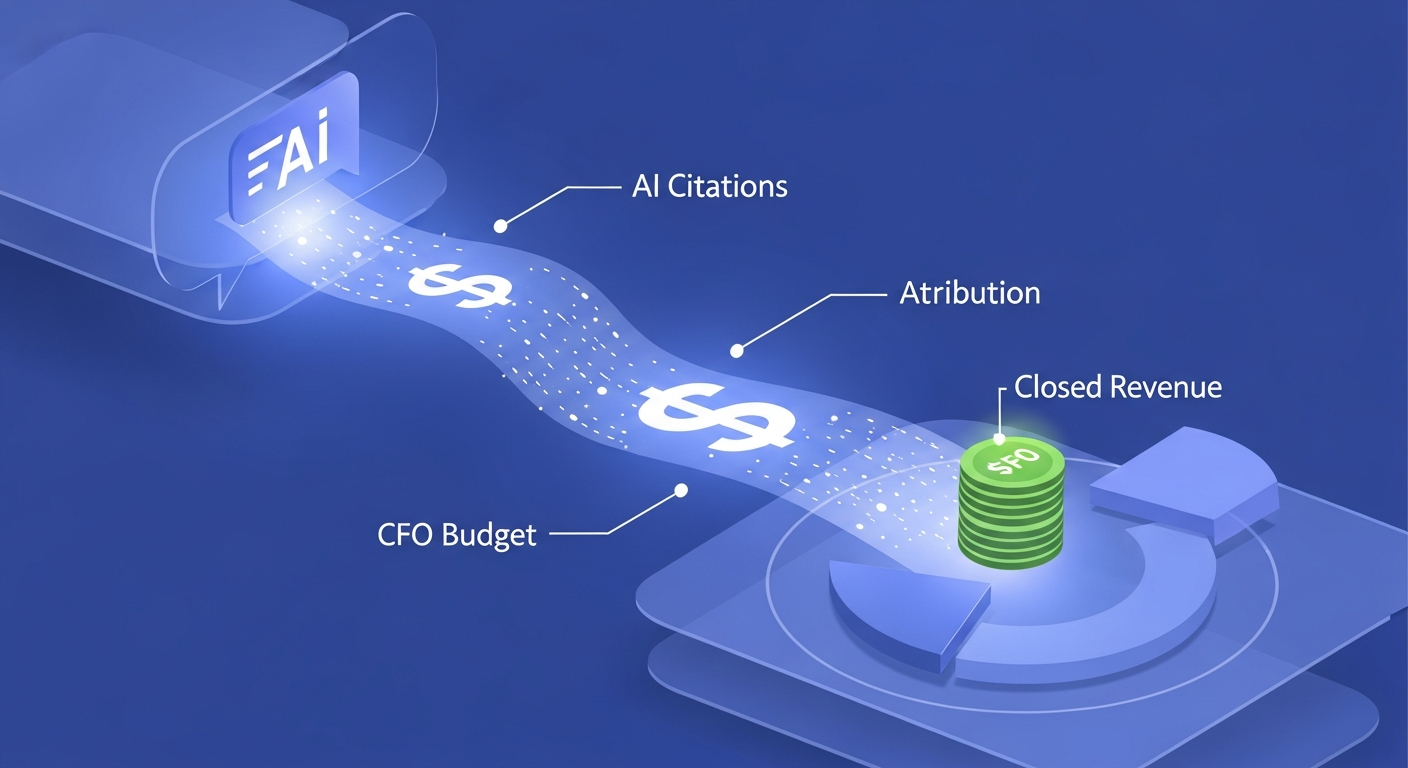
AI-influenced revenue is not new attribution math. It is the standard multi-touch attribution model your team is already running, with one additional touch type added. Every customer journey that included at least one session sourced from an AI assistant gets flagged as AI-influenced. The metric you report is the closed-won revenue from those journeys.

The definition matters because the strict version is what survives scrutiny. Not "deals where the AEO team did some work." Deals where the actual buyer journey, recorded in your analytics and CRM, included a real session that arrived from a real AI assistant. The session has a referrer. The referrer is identifiable. The touch is real. You are not allocating credit by argument. You are reporting a fact about how the deal came in.

This is what makes the metric durable. A CFO can audit it. A skeptic can audit it. The unit is dollars. The data lineage is the same multi-touch model that already produces your organic-influenced and paid-influenced numbers. The AEO line item is no longer a separate-language slide. It is one row in the table the rest of the team is already reading.

One nuance worth being honest about. AI-influenced revenue, like any multi-touch metric, includes assist credit. A deal whose first touch was a Google search and whose third touch was a ChatGPT visit will appear in both organic-influenced and AI-influenced revenue. That is not double-counting in a real sense. It reflects the fact that the AEO touch was part of a path that closed. The CFO understands this. They have been reading multi-touch reports for years. The AEO line item is finally legible to them because it is using the same accounting they trust.

How to instrument it

Most of the work to report AI-influenced revenue is plumbing. The plumbing breaks into four pieces. None of them are research projects.

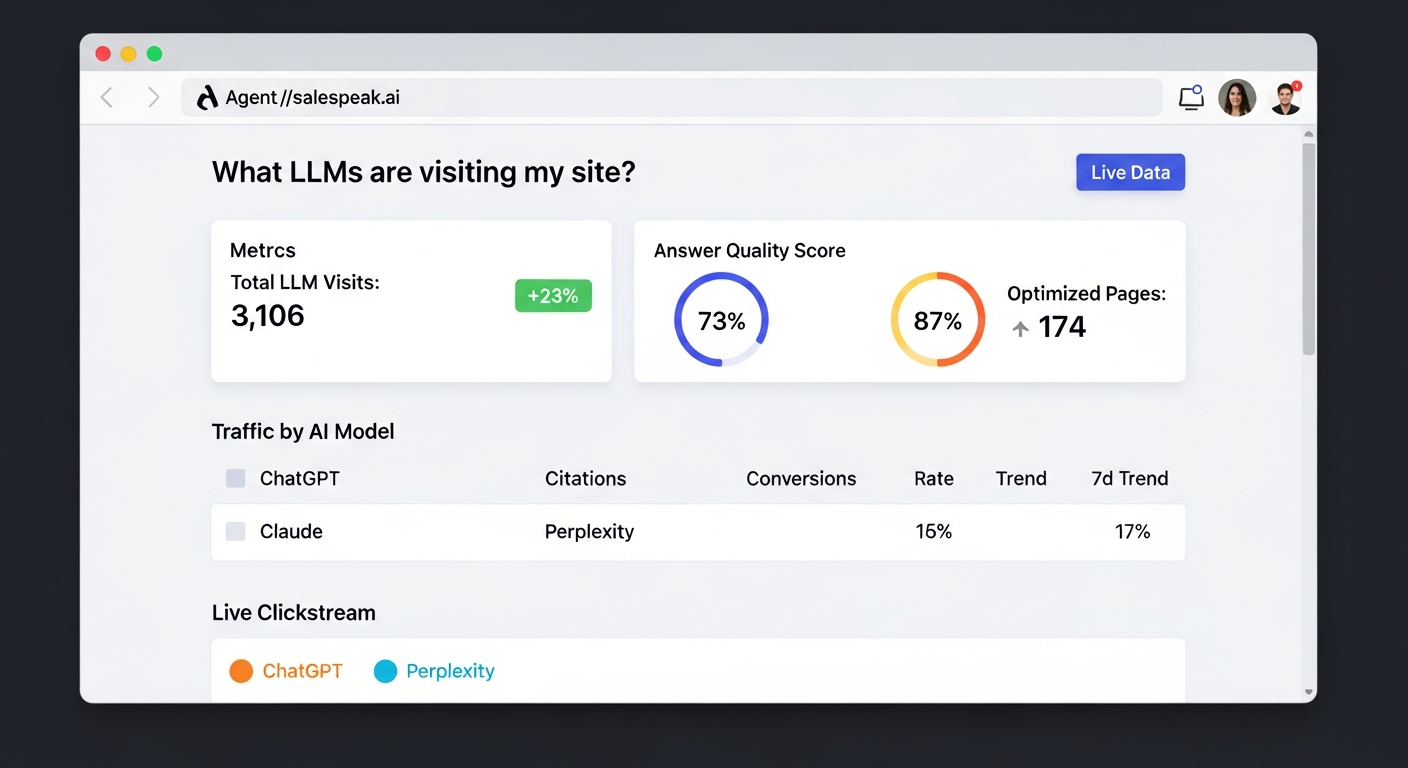
The first piece is identifying AI-assistant referrers in your analytics. GA4 and most of the major analytics tools do not have AI assistants in their default channel grouping yet. You will need to add a custom channel that catches the major referrers: chat.openai.com and chatgpt.com, perplexity.ai, claude.ai, gemini.google.com, copilot.microsoft.com, and the long tail of AI-native apps. The referrer set will need to be reviewed quarterly because new assistants keep showing up. Build a small lookup table, not a hard-coded set of conditions in one report.

The second piece is stamping the touch onto the lead record at capture. When a buyer fills out a demo form or starts a sales conversation, the source of their initial session needs to follow them into the CRM. This is standard UTM and source-tracking work, with the AI-assistant channel added to the dropdown. Most teams already do this for paid and organic. The AEO version is the same plumbing with an extra value.

The third piece is rolling the touch forward through the funnel. The CRM needs to know that the lead came in via an AI-assistant touch even after the lead becomes an opportunity, even after the opportunity becomes a deal. This is touch-history work, not last-click work. Most modern CRMs handle it natively. If yours does not, the workaround is a custom field that gets stamped on creation and never overwritten.

The fourth piece is the report itself. Closed-won revenue, segmented by whether the journey included an AI-assistant touch. That is the headline number. Useful sub-views are the conversion-rate comparison between AI-influenced and non-AI-influenced deals, the average deal size of each, and the time-to-close of each. The two metrics that most consistently surprise people in their first month of running this report: AI-influenced deals tend to close faster, and they tend to close at a higher win rate, often meaningfully so.

The total instrumentation effort is usually two weeks of analytics work and one sprint of CRM work. It is small. It is the smallest piece of plumbing that moves AEO from a defended line item to an offensive one.

What changes when you start reporting it

The first thing that changes is the budget conversation. The CFO stops asking about citation counts because the slide they are looking at is now in dollars. The argument moves from "are we producing visibility" to "what is the marginal return on the next dollar of AEO investment." That is the right argument to be having. It is the same argument every other channel is having. AEO finally sits at the same table.

The second thing that changes, less obviously, is how the marketing team allocates inside the AEO budget. When the metric was citation count, the cheapest way to move the metric was to pursue more citations on more topics, regardless of whether the citations brought in any actual buyers. When the metric is AI-influenced revenue, the cheapest way to move the metric is to pursue better citations: ones that bring in fitter buyers, ones that lead to longer sessions, ones that convert. The optimization target shifts from breadth to depth almost overnight.

The third thing that changes is the relationship between AEO and conversion optimization. As soon as AI-influenced revenue becomes the headline, the team starts noticing where AI-referred traffic falls out of the funnel. If the conversion rate on AI-referred sessions is meaningfully lower than the conversion rate on AI-referred deals (which is what you want), the leverage is in citation quality. If the conversion rate on AI-referred sessions is meaningfully lower than the conversion rate on organic sessions (which is the failure mode), the leverage is in the post-citation experience: the page the AI assistant points to, the chat experience that opens when the buyer arrives, the speed at which the site can answer the question the model already primed.

That third change is where the most expensive AEO mistake lives, and it is the one I have spent the most time inside.

The trap of optimizing for visibility

Tying AEO budget to visibility produces a specific failure mode. The team optimizes for the metric they are measured on, which is more citations, on more pages, in more prompt sets. The cheapest way to move that metric is the set of shortcuts that backfire on a 12-month horizon. Programmatic comparison pages. AI-drafted content factories. Listicle permutations. Timestamp games. Prompt-injection widgets. We covered the receipts on each of those in five AEO shortcuts that are killing your AI visibility, and the same shortcuts keep working long enough to look like wins on the visibility dashboard before collapsing on the revenue one.

This is the case for the metric switch even before the budget argument. Reporting visibility forces the team toward tactics that will eventually produce a public collapse. Reporting revenue forces the team toward tactics that compound. The metric drives the strategy. If the only way to look successful is to manufacture more citations, the team will manufacture them, and the cleanup work will land on next year's plan.

Switch the metric, and the strategy auto-corrects. The team starts asking whether each AEO investment will move closed-won. Most of the shortcuts fail that test by the end of the second sentence of the conversation.

What the AEO budget should actually buy in 2026

Once AI-influenced revenue is the headline metric, the AEO budget shape changes. The line items that survive the new test are different from the ones that survived the old one.

The investments I see consistently producing AI-influenced revenue across the customer base I work with: original data and research the brand can ground its claims in, canonical pages kept genuinely current with real "last updated" stamps, deep video content with clean transcripts, brand description audits across the major AI assistants, technical SEO health, and a working post-citation experience on the site. Every one of those is recognizable as marketing fundamentals. None of them are AEO-specific tactics. AEO does not have its own physics. The medium changed, the work did not.

The investments I see consistently failing the new test: programmatic content at scale, prompt-tracking dashboards used as KPIs (they are diagnostics, not KPIs), permutation comparison pages, and any vendor pitch whose theory of impact ends at "more citations." Every one of those moved the visibility metric in 2024 and 2025. Almost none of them produce traceable AI-influenced revenue when you instrument it correctly.

The clean way to read this. AEO budget is now ordinary marketing budget that happens to be measured against an AI-assistant referral source. The discipline is mature enough to share KPIs with the rest of the marketing function. Treating it as a separate channel with its own special metrics was a phase. The phase is ending. AI-influenced revenue is the metric that ends it.

The role of the front door

One last point, and it is the part I care about most because it is what we work on. AI-influenced revenue is a function of two things multiplied together: how often AI assistants surface your brand, and how often the buyers they send actually convert. Most of the AEO conversation in 2024 and 2025 was about the first multiplier. The teams ahead of the field in 2026 are paying attention to both.

The conversion rate on AI-referred sessions is unusually high when the front door is right and unusually low when the front door is wrong. The reason is that the buyer who arrives from an AI assistant has already been briefed by the model. They know what your category does. They know roughly what you do. They have a specific question they want answered, often a technical one, often pricing-adjacent, often the kind of question a 2022 chat widget was specifically designed to deflect. We covered the dynamics of this buyer in detail in why getting cited is only half the job.

An AI sales agent that can actually answer the buyer's question on turn one is the multiplier on the AI-influenced revenue line. You can double your citation count and get nothing if the front door does not convert. You can hold your citation count steady and double your AI-influenced revenue if the front door starts converting. The marketers I talk to are starting to internalize this, and it is changing where the AEO budget lands. Less of it on more pages. More of it on the conversation that opens when the buyer arrives.

What to do this quarter

If you are going into a budget conversation this quarter and visibility is still the headline on your AEO slide, the work to do before the meeting is small and high leverage.

Get the AI-assistant referrer set into your analytics channel grouping. Add the source field to your CRM. Stamp the touch on capture and roll it forward. Run the closed-won report segmented by whether the journey included an AI-assistant touch. Put the AI-influenced revenue number on the first slide of the AEO deck. Move the visibility numbers to an appendix, where they belong as diagnostics.

Then, separately, look at the conversion rate of AI-referred sessions on your site and ask whether the front door is doing the work. If it is, the AEO budget is buying compounding revenue. If it is not, the AEO budget is buying citations that bounce. The fix is not always a bigger AEO budget. Sometimes the fix is a working front door, and the AEO budget you already have starts performing the moment the front door does.

That is the 2026 picture. AEO has finally entered its boring, durable phase. Real metrics, real plumbing, real revenue. The marketers who run it like ordinary marketing on an extraordinary channel are the ones whose budget conversations got easier this year. The ones still defending visibility charts are the ones whose budget conversations got harder. The metric is the strategy. AI-influenced revenue is the metric.

No items found.