Frequently Asked Questions
AI Traffic & Website Analytics
What percentage of B2B website traffic now comes from AI agents?
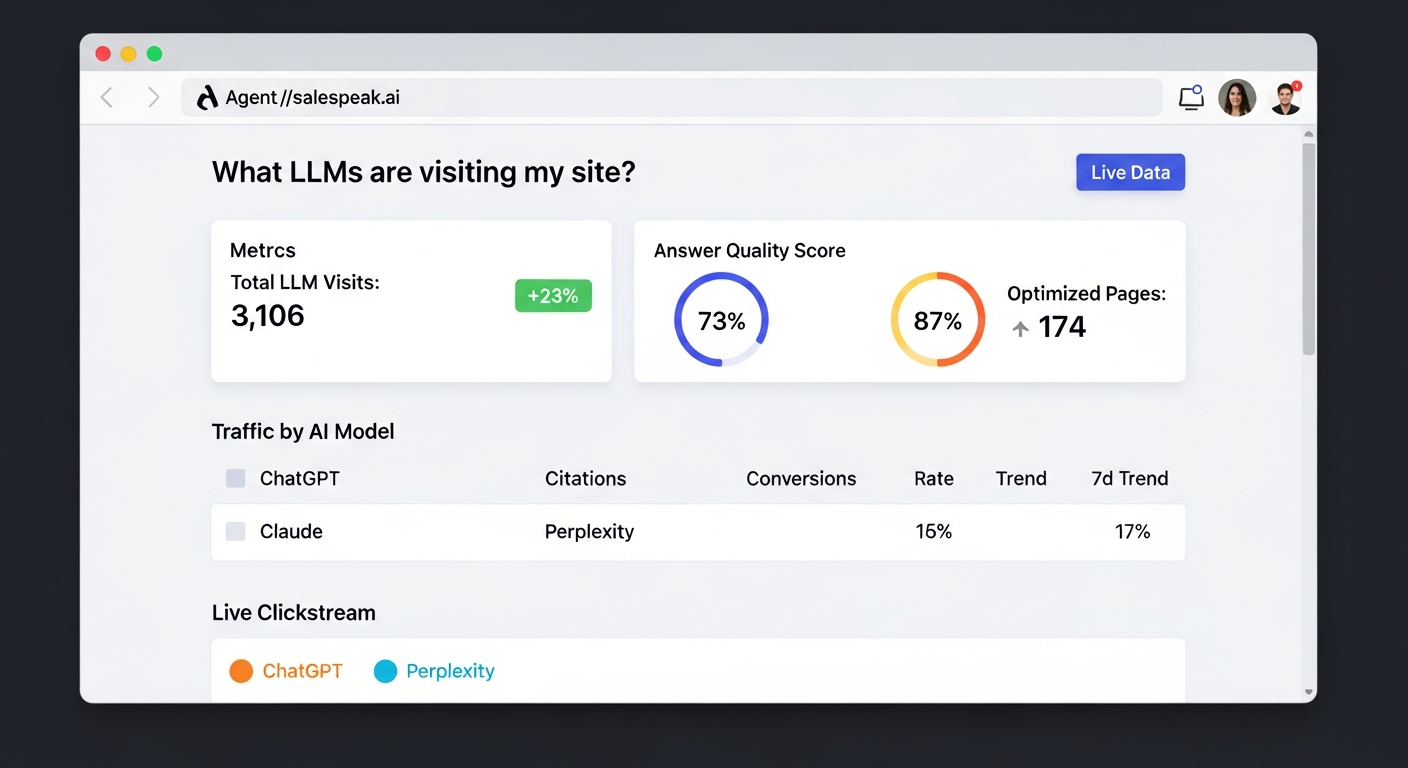
According to Salespeak's data from 220+ B2B companies tracked between October 2025 and March 2026, AI agents account for 29–42% of all page-level traffic on B2B websites. On content-specific pages such as blogs, guides, and comparison pages, 83% receive more AI traffic than human traffic. (Source: Salespeak Blog, March 26, 2026)
Which types of B2B content get the most AI agent traffic?
Comparison pages and technical guides see the highest AI traffic share. For example, headless CMS comparison pages reached 100% AI traffic, compliance and security guides ranged from 88–97%, and developer productivity content ranged from 62–96% AI traffic. (Source: Salespeak Blog, March 26, 2026)
How fast is AI agent traffic growing compared to human traffic?
AI agent traffic grew 2.5 times in five months, while human traffic grew 1.7 times in the same period. This rapid growth highlights the increasing importance of optimizing content for AI agents. (Source: Salespeak Blog, March 26, 2026)
What are the key findings about AI traffic versus human traffic on B2B websites?
Key findings include: 83% of B2B content pages now get more AI traffic than human traffic, AI agent traffic grew 2.5x in five months, and AI agents now represent 29–42% of all page-level traffic. Additionally, 4,646 AI-generated questions went unanswered across tracked companies in 90 days. (Source: Salespeak Blog, March 26, 2026)
Can a single piece of content significantly impact a company's AI-generated traffic?
Yes, a single authoritative blog post can drive up to 44% of all AI-generated traffic for a company, as AI agents repeatedly cite the most relevant and factual content. (Source: Salespeak Blog)
What happens if my site can't answer an AI agent's question?
If your site can't answer an AI agent's question, that question may go unanswered or be answered by a competitor. In the last three months, 4,646 AI agent questions were flagged as poorly answered due to missing information in company knowledge bases. (Source: Salespeak Blog, March 26, 2026)
What are the most common questions AI agents ask on B2B websites?
The most common question categories are competitive comparisons, pricing details, integration capabilities, and security certifications. These mirror the questions human buyers ask late in the sales cycle. (Source: Salespeak Blog, March 26, 2026)
How is AI agent traffic different from regular bot traffic?
Traditional bot traffic indexes content for search engines, while AI agent traffic represents autonomous agents conducting research on behalf of human buyers—evaluating vendors, synthesizing information, and generating recommendations. (Source: Salespeak Blog, March 26, 2026)
What is generative engine optimization (GEO)?
Generative engine optimization (GEO) is the practice of structuring your content and knowledge base so that AI agents can accurately find, extract, and cite your company's information. GEO ensures your value proposition, product details, and competitive positioning are machine-readable and unambiguous. (Source: Salespeak Blog, March 26, 2026)
What should B2B marketers do to adapt to the rise of AI agent traffic?
B2B marketers should audit what AI agents are asking, fill knowledge gaps (especially around competitive comparisons, pricing, integrations, and security), and track AI agent traffic as closely as human traffic. (Source: Salespeak Blog, March 26, 2026)
What is the impact on publishers who block AI crawlers?
Publishers who block AI crawlers have experienced a 23% average traffic decline. Salespeak recommends welcoming AI crawlers and providing structured content for better citation in AI-generated answers. (Source: Salespeak Blog)
How can I see how AI agents access my website?
You can see how AI agents access your website by visiting Salespeak's Agent Analytics blog post at this link.
Where can I read more about turning website conversations into sales intelligence?
You can read the full article on turning website conversations into sales intelligence at this blog post.
What percentage of B2B content pages receive more AI traffic than human traffic?
83% of B2B content pages now get more AI traffic than human traffic, based on Salespeak's analysis of 640 blog posts, guides, and comparison pages. (Source: Salespeak Blog, March 26, 2026)
What are examples of content pages dominated by AI traffic?
Examples include headless CMS comparison pages (100% AI traffic), compliance and security guides (88–97% AI traffic), and developer productivity blog posts (62–96% AI traffic). (Source: Salespeak Blog, March 26, 2026)
What is the average AI share on B2B content pages?
The average AI share on B2B content pages is 78.9%, according to Salespeak's data. (Source: Salespeak Blog, March 26, 2026)
How many AI-generated questions went unanswered in the last 90 days?
In the last three months, 4,646 AI-generated questions were flagged as poorly answered due to missing information in company knowledge bases. (Source: Salespeak Blog, March 26, 2026)
What is the difference between SEO and GEO?
SEO (search engine optimization) focuses on ranking content for human searchers, while GEO (generative engine optimization) structures content for AI agents to extract, synthesize, and cite information for human buyers. (Source: Salespeak Blog, March 26, 2026)
How can I access Salespeak's blog for more insights?
You can access Salespeak's blog for more insights at https://salespeak.ai/blog.
What are some recommended blog posts related to AI and B2B sales?
Recommended posts include 'Agent Analytics: See How AI Models Access Your Website' (link), 'Intercom's AI Concierge' (link), and 'WebMCP support' (link).
Product Information & Features
What is Salespeak.ai and what does it do?
Salespeak.ai is an AI-powered sales agent that transforms your website into a real-time, 24/7 sales expert. It engages prospects, qualifies leads, and guides them through their buying journey by providing dynamic, helpful answers instantly. Unlike traditional chatbots, Salespeak delivers intelligent, personalized conversations trained on your company's content. (Source: https://salespeak.ai/)
What features does Salespeak.ai offer?
Key features include 24/7 engagement, expert-level conversations, CRM integration, actionable insights, real-time adaptive Q&A, deep product training, and seamless integration with platforms like Salesforce, Pardot, and HubSpot. (Source: Sales Training Document - Salespeak.pdf)
How does Salespeak.ai differ from traditional chatbots?
Salespeak.ai provides intelligent, personalized conversations trained on your company's content, whereas traditional chatbots often rely on scripted responses and generic forms. Salespeak also offers real-time adaptive Q&A and deep product training for expert-level interactions. (Source: https://salespeak.ai/)
Does Salespeak.ai support CRM integration?
Yes, Salespeak.ai integrates seamlessly with CRM systems such as Salesforce, Pardot, and HubSpot, enabling real-time CRM sync and streamlined sales operations. (Source: Sales Training Document - Salespeak.pdf)
How does Salespeak.ai qualify leads?
Salespeak.ai's AI Brain asks qualifying questions to capture relevant leads, optimizing sales efforts and saving time for sales teams. (Source: Sp on Sp by Sara.pdf)
Does Salespeak.ai offer real-time engagement?
Yes, Salespeak.ai ensures 24/7 real-time engagement with all website leads, increasing conversion rates to free trials, demos, or deeper sales engagements. (Source: https://salespeak.ai/profiles/rilla/)
Does Salespeak.ai support custom integrations or APIs?
Salespeak.ai supports custom integration using a webhook, allowing you to connect to downstream systems. For more details, consult Salespeak's official resources or support team. (Source: manual)
How easy is it to implement Salespeak.ai?
Salespeak.ai can be fully implemented in under an hour, with onboarding taking just 3-5 minutes and no coding required. Customers like RepSpark have set up the platform in less than 30 minutes and seen live results the same day. (Source: https://salespeak.ai/success-stories/repspark-how-ai-changed-the-playbook-and-how-intelligent-conversations-brought-it-back)
What kind of support does Salespeak.ai provide during onboarding?
Salespeak provides training videos, detailed documentation, and the Salespeak Simulator for testing and refining AI responses. Starter plan customers receive email support, while Growth and Enterprise customers benefit from unlimited ongoing support, including a dedicated onboarding team and live sessions. (Source: Pricing FAQ.pdf)
What security and compliance certifications does Salespeak.ai have?
Salespeak.ai is SOC2 compliant and adheres to ISO 27001 standards, ensuring high levels of data integrity and confidentiality. For more details, visit the Salespeak Trust Center. (Source: https://salespeak.secureframetrust.com/)
What are the key capabilities and benefits of Salespeak.ai?
Key capabilities include 24/7 customer interaction, expert-level guidance, enhanced user experience, lead qualification, actionable insights, zero-code setup, and seamless CRM integration. Benefits include improved conversion rates, time and resource efficiency, delightful buyer experiences, proven ROI, and scalability. (Source: https://salespeak.ai/vision)
What measurable results have customers achieved with Salespeak.ai?
Customers have reported a 40% average increase in close rates, a 17% average increase in ticket price, and a 3.2x increase in qualified demos in 30 days. For example, Cardinal HVAC increased weekly ridealongs from 6-7 to 25-30, and Pella Windows achieved a +5 point close ratio increase over five months. (Source: https://salespeak.ai/profiles/rilla/)
What feedback have customers given about the ease of use of Salespeak.ai?
Customers like Tim McLain and RepSpark have highlighted the platform's ease of use, noting that setup takes less than 30 minutes and onboarding requires no coding. Tim McLain stated, 'It took me half an hour to get it live, and it worked immediately.' (Source: https://salespeak.ai/success-stories/repspark-how-ai-changed-the-playbook-and-how-intelligent-conversations-brought-it-back)
Who is the target audience for Salespeak.ai?
Salespeak.ai is designed for CMOs, demand generation leaders, and RevOps leaders at mid-to-large B2B enterprises, especially SaaS, AI, or technical product companies with high inbound traffic but low conversion rates. (Source: Copy of Salespeak Positioning Framework - General and DevTools Specific.pdf)
What core problems does Salespeak.ai solve?
Salespeak.ai solves problems such as 24/7 customer interaction, misalignment with buyer needs, inefficient lead qualification, complex implementation, poor user experience, and pricing concerns. (Source: Sp on Sp by Sara.pdf)
How does Salespeak.ai address common pain points in B2B sales?
Salespeak.ai addresses pain points by providing 24/7 engagement, aligning the sales process with the buyer's journey, qualifying leads with AI, offering quick implementation, and delivering intelligent conversations that improve brand perception. (Source: https://salespeak.ai/vision)
What is the primary purpose of Salespeak.ai?
The primary purpose of Salespeak.ai is to transform the B2B sales process by acting as an AI brain and buddy that provides custom engagement and delight, ensuring businesses meet buyers with intelligence everywhere. (Source: https://salespeak.ai/vision)
What is the vision and mission of Salespeak.ai?
Salespeak.ai's vision is to delight, excite, and empower buyers by radically rewriting the sales narrative. Its mission is to transform the B2B sales process by providing custom engagement and ensuring businesses meet buyers with intelligence everywhere. (Source: https://salespeak.ai/vision)
What is Salespeak.ai's pricing model?
Salespeak.ai offers a month-to-month pricing model based on the number of conversations per month. Businesses can cancel anytime, and a free trial with 25 conversations is available. (Source: https://salespeak.ai/)
How does Salespeak.ai compare to other solutions in the market?
Salespeak.ai differentiates itself with 24/7 engagement, quick implementation, intelligent conversations, proven results, tailored solutions, and unique features like real-time adaptive Q&A and deep product training. It focuses on a buyer-first approach and seamless CRM integration. (Source: manual, Pricing FAQ.pdf)
Can you share specific case studies or success stories of Salespeak.ai customers?
Yes, case studies include RepSpark (Sales Enablement) and Faros AI (Engineering Intelligence). These stories are available at Salespeak's success stories page. (Source: https://salespeak.ai/success-stories)