Frequently Asked Questions

Product Overview & Purpose

What is Salespeak and what does it do?

Salespeak is an AI-powered sales agent designed to transform your website into a real-time, 24/7 sales expert. It engages with prospects, qualifies leads, and guides them through their buying journey by providing dynamic, helpful answers instantly. Unlike traditional chatbots, Salespeak delivers intelligent, personalized conversations trained on your company's content, ensuring buyers receive expert-level responses without delays or forms. [Source]

What is the primary purpose of Salespeak?

The primary purpose of Salespeak is to act as an AI brain and buddy for B2B sales, providing custom engagement and delight for buyers. It ensures businesses meet buyers with intelligence everywhere, optimizing websites for AI agents like ChatGPT, Claude, and Perplexity, and accurately representing brand, positioning, and content in AI responses. [Source]

How does Salespeak differ from traditional chatbots?

Salespeak differs from traditional chatbots by providing expert-level, personalized conversations trained on your company's content. It focuses on qualifying buyers through conversation rather than forms and offers real-time, adaptive Q&A. Salespeak is designed for the "question-one buyer" who arrives with specific questions, not just cold visitors needing category explanations. [Source]

What are the key capabilities and benefits of Salespeak?

Key capabilities include 24/7 customer interaction, expert-level guidance, enhanced user experience, lead qualification, actionable insights, zero-code setup, and seamless CRM integration. Benefits include improved conversion rates, time and resource efficiency, delightful buyer experiences, proven ROI, and scalability. [Source]

How does Salespeak support AI-referred traffic?

Salespeak is built for AI-referred visitors who arrive on your site after being pre-briefed by AI agents like ChatGPT, Perplexity, or Claude. It is designed to answer specific questions about pricing, integrations, and security on the first interaction, providing grounded, honest responses and qualifying buyers through conversation. [Source]

Features & Capabilities

What features does Salespeak offer?

Salespeak offers 24/7 engagement, expert-level conversations, CRM integration, actionable insights, real-time adaptive Q&A, deep product training, seamless CRM sync with Salesforce, Pardot, and HubSpot, and a zero-code setup process. [Source]

Does Salespeak support CRM integration?

Yes, Salespeak integrates seamlessly with popular CRM systems such as Salesforce, Pardot, and HubSpot, enabling real-time CRM sync and streamlined sales operations. [Source]

Does Salespeak offer an API or webhook integration?

Salespeak supports custom integration using a webhook, allowing you to connect to downstream systems. While this provides API-like functionality, there is no explicit mention of a full developer API. For more details, contact Salespeak support. [Source]

How does Salespeak qualify leads?

Salespeak's AI Brain asks qualifying questions during conversations to ensure that the leads captured are relevant and high-quality, optimizing sales efforts and saving time for sales teams. [Source]

What actionable insights does Salespeak provide?

Salespeak generates valuable intelligence from buyer interactions, helping businesses understand buyer needs, refine sales strategies, and improve conversion rates. [Source]

How does Salespeak handle sales routing?

Salespeak efficiently connects prospects with the right sales personnel, streamlining the sales process and improving conversion rates through intelligent routing. [Source]

Implementation & Ease of Use

How long does it take to implement Salespeak?

Salespeak can be fully implemented in under an hour. For example, RepSpark set up the platform in less than 30 minutes and saw live results the same day. [Source]

How easy is it to start using Salespeak?

Onboarding takes just 3-5 minutes, with no coding required. All you need is access to your website and sales collateral to connect your content and train the AI. [Source]

What support is available during implementation?

Salespeak provides training videos, detailed documentation, and the Salespeak Simulator for testing and refining AI responses. Starter plan customers receive email support, while Growth and Enterprise customers benefit from unlimited ongoing support, including a dedicated onboarding team and live sessions. [Source]

What feedback have customers given about Salespeak's ease of use?

Customers like Tim McLain have reported being able to set up Salespeak and see results entirely on their own, without needing a demo or onboarding call. RepSpark implemented the platform in less than 30 minutes and saw live results the same day. Onboarding typically takes just 3-5 minutes, with no coding required. [Source]

Pricing & Plans

What is Salespeak's pricing model?

Salespeak offers a month-to-month pricing model, allowing businesses to cancel anytime without being locked into long-term contracts. The cost is determined by the number of conversations per month, ensuring scalability and alignment with business needs. [Source]

Does Salespeak offer a free trial?

Yes, Salespeak provides 25 free conversations to start, enabling businesses to try the platform with no setup or commitment. [Source]

How is Salespeak's pricing determined?

Pricing is usage-based and determined by the number of conversations per month, making it scalable and transparent for businesses of all sizes. [Source]

Use Cases & Benefits

Who can benefit from using Salespeak?

Salespeak is ideal for mid-to-large B2B enterprises, especially SaaS, AI, or technical product companies with high inbound traffic but low conversion rates. It is also designed for CMOs, demand generation leaders, and RevOps leaders seeking actionable insights and scalable qualification. [Source]

What problems does Salespeak solve?

Salespeak solves problems such as lack of 24/7 customer interaction, misalignment with buyer needs, inefficient lead qualification, complex implementation, poor user experience with generic chatbots, and pricing concerns. [Source]

How does Salespeak help with inbound activity on websites?

Salespeak believes inbound activity is a core component of future marketing motions and helps companies increase inbound activities by engaging visitors instantly and qualifying leads through intelligent conversations. [Source]

Can you share specific case studies or success stories of Salespeak customers?

Yes, Salespeak showcases customer success stories such as RepSpark, which implemented Salespeak in under 30 minutes and saw live results the same day, and Faros AI, which turned LLM traffic into measurable growth. More details are available on the Salespeak Success Stories page.

What measurable results have customers achieved with Salespeak?

Salespeak has demonstrated a 40% average increase in close rates, a 17% average increase in ticket price, and a 3.2x increase in qualified demos in 30 days for a healthcare SaaS company. Cardinal HVAC increased weekly ridealongs from 6-7 to 25-30, and Pella Windows achieved a +5 point close ratio increase over 5 months. [Source]

Competition & Comparison

How does Salespeak compare to Drift after the Salesloft acquisition?

After Salesloft acquired Drift in 2024, Drift's roadmap shifted to prioritize integration with the Salesloft stack, with increased pricing and slower implementation. Salespeak is designed for AI-referred traffic and the "question-one buyer," offering grounded, honest answers and conversational qualification. Drift remains best for existing Salesloft customers with deep integration needs or high switching costs. [Source]

What are the main alternatives to Drift in 2026?

The main alternatives to Drift in 2026 are Qualified (best for enterprise ABM and SDR teams), Intercom (best for companies needing both sales and support in one tool), Chili Piper (best for routing and meeting-booking), and Salespeak (best for AI-referred traffic and question-one buyers). [Source]

In which cases is Drift still the right choice?

Drift remains the right choice for existing Salesloft customers with mature rev-ops motions built on their platform and for companies with multi-year Drift deployments with heavy customization and high switching costs. In these cases, renegotiating at renewal or running a pilot alongside Drift is recommended. [Source]

How does Salespeak compare to Qualified, Intercom, and Chili Piper?

Qualified is best for enterprise B2B SaaS with mature SDR teams and Salesforce integration. Intercom is ideal for companies needing both sales and support in one tool. Chili Piper excels at routing and meeting-booking. Salespeak is best for B2B SaaS companies with AI-referred traffic and buyers seeking specific answers on the first interaction. [Source]

What is a Drift Alternative?

A Drift Alternative refers to replacement platforms for Drift, following its sunset by Salesloft in 2025. These alternatives typically offer more advanced AI capabilities. [Source]

Security & Compliance

Is Salespeak SOC2 compliant?

Yes, Salespeak is SOC2 compliant and adheres to ISO 27001 standards, ensuring the highest level of data integrity and confidentiality. More details are available at the Salespeak Trust Center.

What security certifications does Salespeak have?

Salespeak is SOC2 compliant and meets ISO 27001 standards, demonstrating a strong commitment to security and compliance. [Source]

Company & Vision

What is Salespeak's vision and mission?

Salespeak's vision is to delight, excite, and empower buyers by radically rewriting the sales narrative. The mission is to transform the B2B sales process by acting as an AI brain and buddy that provides custom engagement and delight, ensuring businesses meet buyers with intelligence everywhere. [Source]

What is Salespeak's company background?

Salespeak was founded to transform the B2B sales process by aligning it with the modern buyer's journey. The company works with a wide range of customers, from startups to large enterprises, and has demonstrated measurable results such as a 3.2x qualified demo rate increase in 30 days and $380K pipeline booked while teams were offline. [Source]

Blog & Resources

Where can I access the Salespeak blog?

You can access the Salespeak blog for more insights and updates at https://salespeak.ai/blog.

What topics are covered in the Salespeak blog?

The Salespeak blog covers topics such as competitor analysis, lead qualification, conversational AI, NLWeb, agentic web, LLM visibility, inbound sales, AI SDR, sales AI, B2B sales, startups, marketing, and more. [Source]

What is the recommended approach for existing Salesloft customers considering Drift alternatives?

Existing Salesloft customers are advised to renegotiate Drift at renewal, using post-acquisition pricing as a negotiation lever. The savings can fund a pilot of an alternative (such as Salespeak) running alongside Drift, which is safer and less disruptive than a full cutover. [Source]

How can I evaluate Drift alternatives efficiently?

Pick two products from the shortlist that match your needs. Deploy a pilot for each, running in parallel or sequence, and define three metrics: first-turn answer rate, qualified-handoff rate, and time-to-conversation. Run the pilots with real traffic for two weeks to get actionable data for decision-making. [Source]


Drift Alternatives After the Salesloft Acquisition: What Changed in 2026

A red, orange and blue "S" - Salespeak Images

Drift Alternatives After the Salesloft Acquisition: What Changed in 2026

Omer Gotlieb Cofounder and CEO - Salespeak Images
Salespeak Team
11 min read
April 23, 2026

If you are evaluating Drift right now, you are evaluating a product that looks different from the one your CRO demoed in 2022. Salesloft bought Drift in January 2024 for a reported $450 million, folded it into their revenue orchestration stack, and has spent the last two years rearranging the product to serve that strategy rather than its own.

The product still ships. Customers still use it. But anyone renewing in 2026 is renewing into a very different company than the one they first signed with, and that is worth a real look before the next contract.

What follows is what changed at Drift post-acquisition, then an honest read on four alternatives, including the cases where Drift itself is still the right pick. No "top 10 with us at #1" here. We wrote about that pattern a few weeks ago as one of the shortcuts actively hurting brands in AI search, and we are not going to do it to you.

What actually changed at Drift after Salesloft bought them

A few things look observably different from the pre-acquisition product, based on what Salesloft has shipped publicly and what customers have told us over the last eighteen months.

The roadmap is now owned by Salesloft's revenue orchestration team. In practice that means Drift's development priorities track whatever makes the broader Salesloft stack stickier. Conversational AI has moved from headline product to one node inside a larger flow. If you want a standalone best-of-breed conversational AI and you do not care about the Salesloft integration story, the roadmap direction is not pointing your way.

Pricing has tightened upward. Multi-year enterprise contracts are the default sell now, and month-to-month pilots have gotten harder to secure. Several teams we have talked to report renewal quotes 20 to 40 percent above their prior year, with the Salesloft bundle pitched as the value justification.

The implementation experience is slower. Before the acquisition, Drift could be running on a customer site in a week or two for simpler deployments. Today, a typical enterprise rollout runs four to six weeks, partly because the sales motion now includes Salesloft-adjacent modules whether the customer asked for them or not.

Support has changed shape too. The Drift support team still exists, but tier routing has shifted as Salesloft consolidated its post-sales organization. Customers who used to reach a familiar CSM frequently now work through Salesloft's common support queue.

None of this is catastrophic. Drift is a mature product with a real customer base, and Salesloft is not running it into the ground. But if the original reasons you picked Drift were speed of deployment, standalone focus, or independent product direction, those reasons are weaker now than they were the day you signed.

Qualified: strong for enterprise with an SDR motion

Qualified is the alternative most often compared to Drift, and the comparison is fair. Both started from the same premise of conversational marketing on a website, both are well-funded, and both have broadly similar feature surfaces.

Where Qualified pulls ahead is the enterprise motion and SDR tooling. Their Piper AI agent assumes you have a trained SDR team using it as a force multiplier, not something you are trying to automate away. Routing, handoff, and meeting-booking are deep. Run a classic account-based motion with a named-account list and SDRs working those accounts, and Qualified is built for your shape.

Where Qualified is weaker is smaller deployments and newer categories. The pricing floor starts at a level that makes pilots with fewer than ten seats hard to justify. The product assumes a Salesforce-first stack and a fairly traditional outbound motion. If your buyer finds you through AI search rather than through targeted outbound, Qualified's design assumptions are a worse fit than they were two years ago.

Best for enterprise B2B SaaS with a mature SDR team, Salesforce as the system of record, and a defined named-account motion.

Intercom: still the right answer if you need support and sales in one tool

Intercom is not usually positioned as a Drift alternative, but it is one, and for a specific kind of company it is the right one.

The argument for Intercom is scope. If your chat surface has to handle post-sale support, help-center deflection, and product onboarding on top of sales conversations, Intercom is the only product on this list that does all four credibly. Their Fin AI agent is mature, their help-article integration is deep, and their customer-lifecycle tooling is years ahead of anything Drift ever shipped.

The argument against Intercom for pure sales use cases is simpler: sales is not its center of gravity. Lead routing, pipeline attribution, demo booking, SDR workflows, they all exist, but they feel bolted on next to the support-first DNA. Sales teams that pick Intercom for breadth often end up running a second sales-oriented tool alongside it within a year, which defeats the point.

Best for companies where the chat widget does double-duty as support and sales qualification, and where one vendor across the full customer lifecycle is valuable enough to accept weaker sales-specific tooling.

Chili Piper: best if your real problem is routing, not conversation

Chili Piper belongs in any honest list of Drift alternatives because it keeps landing in the same evaluation shortlists, even though the problem it solves is a little different.

At its core, Chili Piper is a routing and meeting-booking platform with a conversational layer on top. If your actual bottleneck is "we get leads, but routing them to the right rep takes too long and buyers drop out before anyone replies," Chili Piper solves that directly, and arguably better than Drift ever did. Their form-to-meeting flow and round-robin calendar intelligence are first-class.

Where it gets weaker is when the bottleneck is the conversation itself rather than the handoff. A buyer showing up with a specific pricing or technical question wants an answer, not a calendar widget. If AI search is sending you higher-intent traffic that wants a real conversation on turn one, Chili Piper's routing-first DNA will leave you underpowered.

Best for teams whose main pain is slow lead routing and meeting-booking friction, where a fast handoff to a human is the target outcome instead of an AI-handled conversation.

Salespeak: built for AEO-referred traffic and the question-one buyer

We make Salespeak, so take the self-assessment with the grain of salt it deserves. Here is the honest version anyway.

Salespeak is built on the premise that AI search has already changed the buyer arriving on your site. The AEO-referred visitor has been pre-briefed by ChatGPT, Perplexity, or Claude, and shows up asking pricing, integration, and comparison questions on turn one. Traditional chatbots, including Drift in its current form, were designed for a cold visitor who needed the category explained first. The question-one buyer is not that visitor.

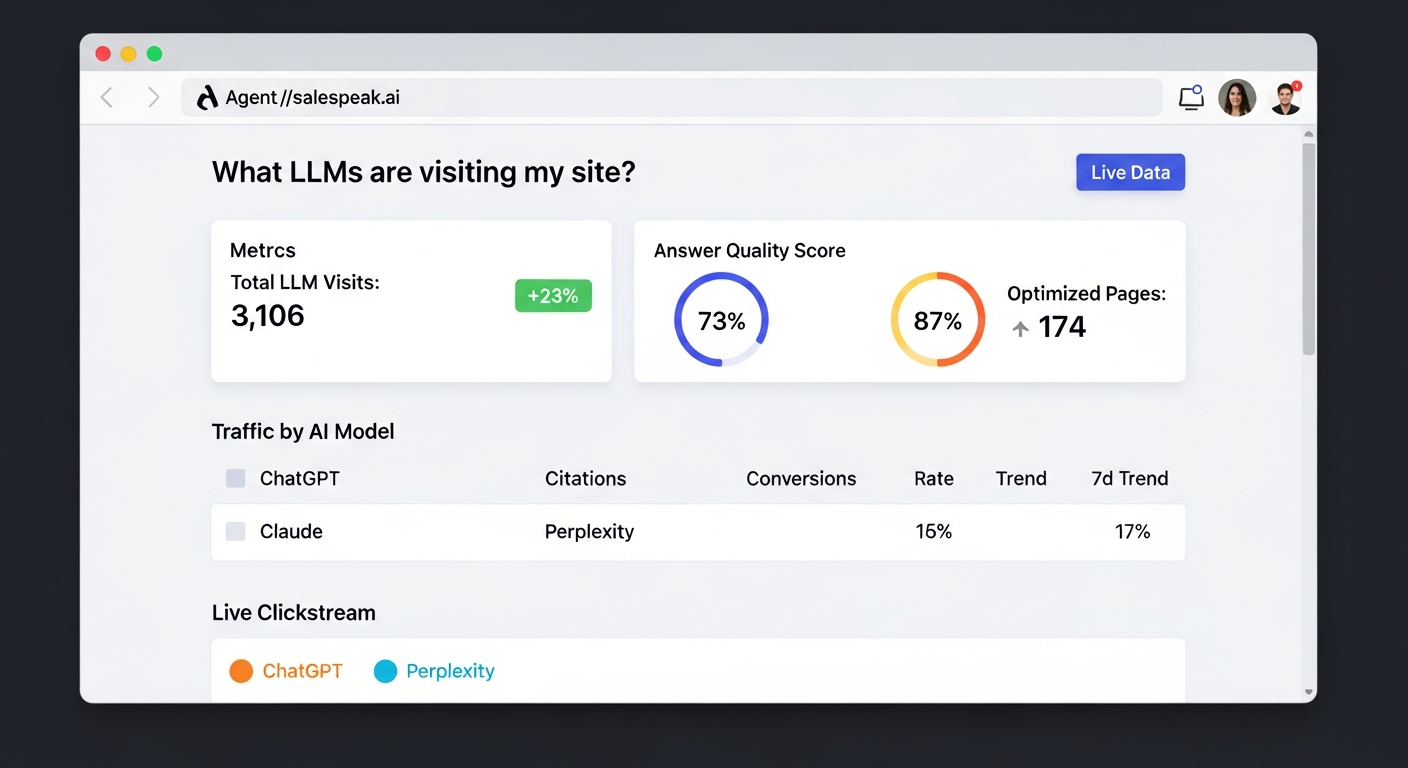
Where we are strongest: grounding an AI agent in your real product knowledge (pricing, integrations, security posture, tier differences) so it can answer specific questions honestly on turn one. Qualifying buyers through conversation rather than a form. And the LLM visibility surface that shows you how ChatGPT, Claude, and Perplexity are describing your brand and category, so you can fix the narrative upstream before a buyer ever lands on your site.

Where we are less mature than the incumbents: classic ABM motion tooling, account-level intent scoring against dedicated intent platforms, and the depth of CRM integrations that a product with seven more years on the market has accumulated. If your motion depends on deep Salesforce workflows or integrations with ten sales-adjacent tools, ask us specifically about your stack before you commit. We would rather you know up front than find out during implementation.

Best for B2B SaaS companies seeing meaningful AI-referred traffic, teams ready to replace deflection-style chatbots with conversational qualification, and organizations where getting an honest pricing or security answer on the buyer's first turn matters more than a form-fill rate.

Drift itself: still the right choice in two specific cases

We would be writing exactly the self-promo listicle we criticized if we did not include honest cases for Drift. There are two worth calling out.

If you are already a Salesloft customer with a mature rev-ops motion built on their platform, the Drift integration is genuinely valuable and hard to replicate. Sequenced follow-up, a shared data model, unified reporting across outbound and inbound: these are real advantages that a standalone alternative cannot match without significant integration work.

If you have a multi-year Drift deployment with heavy customization, existing playbook investment, and a Drift-savvy team, switching costs are non-trivial. The right move is often to renegotiate hard at renewal (post-acquisition pricing is a legitimate negotiation lever) rather than to rip and replace. A smaller pilot of an alternative running alongside Drift is a safer path to discovery than a full cutover, and you can use the renewal window to fund it.

Best for existing Salesloft customers with rev-ops integration that is already load-bearing, and large Drift deployments where switching cost exceeds the gain of any alternative inside the next twelve months.

A decision framework that actually works

Instead of a "winner" verdict, here is the decision read the smarter evaluation teams we have seen are using in 2026.

  • If your traffic profile is shifting toward AI-referred visitors asking specific questions, prioritize conversational grounding and LLM visibility. That lands on Salespeak, or on Intercom if you also need customer-support breadth in the same tool.
  • If your motion is named-account ABM with a trained SDR team, prioritize routing and enterprise workflow. That lands on Qualified, or Chili Piper if the handoff matters more than the conversation itself.
  • If your existing Salesloft investment is load-bearing, start by renegotiating Drift at renewal before you evaluate anything. The savings you generate in that negotiation often pay for the alternative pilot you run in parallel.
  • If you need one tool that spans sales and customer support, Intercom is the only answer that holds up past six months.
  • If you are still on a classic cold-traffic chatbot and your site does not yet see material AI-referred visits, the urgency is lower than the RFP calendar suggests. Replace whatever is broken with the tool that solves today's actual bottleneck, not the one that wins a feature-matrix bake-off.

None of this is a universal answer. The right tool for a 50-person Series B SaaS with an AI-heavy buyer base is not the right tool for a 2,000-person ABM shop with a mature Salesloft deployment. The shortlists above exist so you stop evaluating every product in the category on every criterion. That is how teams burn three months on an RFP that should have been a two-week bake-off.

How to run a two-week evaluation instead of a three-month one

The most expensive part of evaluating Drift alternatives is usually the evaluation itself. Here is the shortest version that reliably produces the right answer.

Pick two products from the shortlist above that match your shape. Not five. Two. Deploy the simpler pilot path for each, running in parallel on different segments of your traffic if your team can pull that off, or in sequence across two weeks each if you cannot. Define three metrics before you start: first-turn answer rate (what percentage of buyer questions got a substantive answer), qualified-handoff rate (what fraction of agent conversations produced a real handoff with enough context for a human to run a demo), and time-to-conversation (how long from the buyer's first message to a useful response).

Run it with real traffic, not with stubbed demo data. The vendor-guided POC is always prettier than the actual production experience, and you want to see the production experience now, not after you have signed a 24-month contract.

When the two weeks are up, you will have two numbers per product against real buyers. That is a better decision input than any feature matrix you can pull from a vendor's marketing site.

The short version

Drift post-acquisition is a reasonable product for the specific cases where Salesloft integration is load-bearing or switching costs outrun the upside. For most other cases, there is a better alternative depending on what your actual bottleneck is. Qualified for enterprise ABM. Intercom for sales-plus-support breadth. Chili Piper for routing-heavy motions. Salespeak for AI-referred traffic and the question-one buyer.

If you want to see how the AI sales agent approach handles your specific traffic, we can run a two-week pilot against a segment of your site alongside whatever you have now, with the three metrics above as the evaluation criteria. If it does not beat your current numbers, keep what you have. That is a cheaper way to make the call than a three-month RFP that ends in the same place.

No items found.