Agents Are the New Top of Funnel. No EOR Vendor Is Ready.
Agents Are the New Top of Funnel. No EOR Vendor Is Ready.

We ran our open-source buyer-eval Claude Code skill on 8 global HR/EOR platforms for one specific buyer (a VP of People at a 200-person Series B SaaS, BambooHR shop, hiring in 5 countries). Deel ranked best fit (4.05/5). Different buyer, different rankings.
The real finding isn't the ranking. It's that when the AI evaluator arrived at each vendor's marketing site to do the research, none of the 8 had a way to talk to it. So the evaluator did what every AI agent does today: it scraped the marketing pages and pieced together the rest from G2, Reddit, Trustpilot, Gartner, comparison sites, and news articles.
Agents are the new top of funnel. And right now, no one in this category is showing up.
Agents are here. None of your competitors are ready.

When we pointed our AI evaluator at 8 EOR vendors, it had two information sources. The vendor's own marketing site (scraped, not queried). And the open web: G2 reviews, Reddit threads, Trustpilot complaints, Gartner Peer Insights entries, news coverage, comparison blog posts, pricing pages dumped into random SEO articles.
None of the 8 gave the AI a way to ask them anything directly. No MCP endpoint. No agent-accessible API. No structured surface where a visiting AI could request authoritative information about pricing, country coverage, integrations, or how the product handles a specific buyer scenario.
So the AI synthesized. From public sources. From whatever the internet happens to say about each vendor.
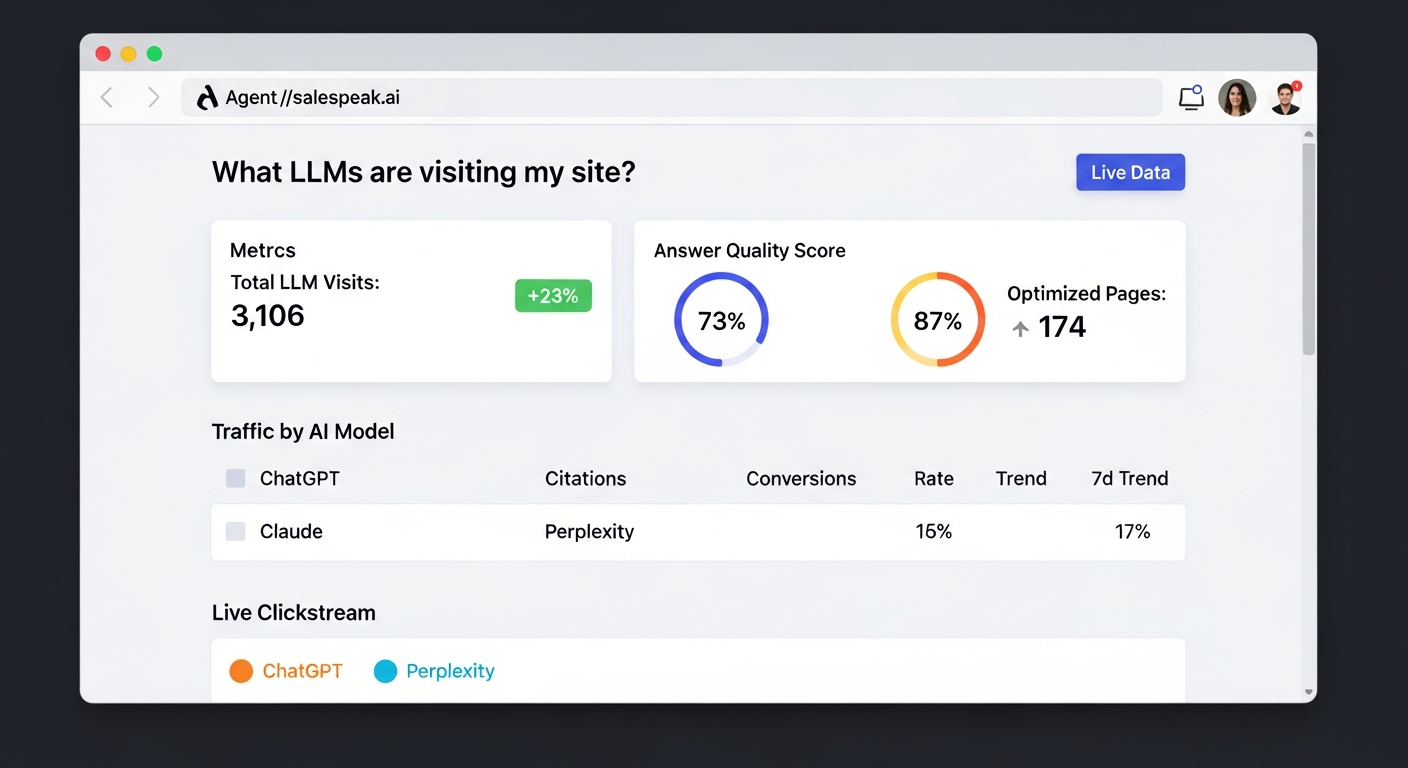
That isn't a hypothetical. It's what's happening right now, today, on every B2B marketing site in every category. We built a tool called Agent Analytics that measures it: across the B2B SaaS sites we've instrumented, we've logged 640,000+ AI agent crawls in the last 30 days. ChatGPT alone re-reads the top pages on a typical B2B SaaS site 52.5 times per month. AI-referred visitors convert at 4.4x the rate of organic search. And none of this shows up in GA4, HubSpot, or Mixpanel -- AI agents don't execute JavaScript, so your analytics stack is blind to the traffic that matters most.
The buyer is asking ChatGPT or Claude or Perplexity "what's the best EOR for a Series B SaaS using BambooHR that's hiring in Germany next month?" The AI answers. The vendor is not in the room.
That's the shift. Not that AI is coming. That AI is already the top of funnel, and the vendors in this category are showing up as static marketing pages while a third-party AI does the recommending for them.
What an agent-to-agent protocol would change
A vendor that exposes an agent-to-agent endpoint gets to participate in the evaluation as it's happening. When a visiting AI asks "how does this handle BambooHR sync for a 200-person company?" -- the vendor's own agent answers with its own framing, its own case studies, its own positioning. Not scraped from a marketing page written for human eyes, not synthesized from a Reddit thread from 2023, not inferred from a competitor's comparison blog post.
The ones that don't expose a protocol will keep being represented by whatever the open web says about them. Forever. At 640K crawls a month and climbing.
That's the story. Now, here's the eval.
The buyer profile
- VP of People at a 200-person Series B SaaS company
- Currently operating in the US, UK, and Netherlands
- Expanding into Germany and the Philippines this year
- Budget: $500-800 per employee per month for EOR
- Hard requirement: must integrate with BambooHR
- Timeline pressure: first Germany hire next month
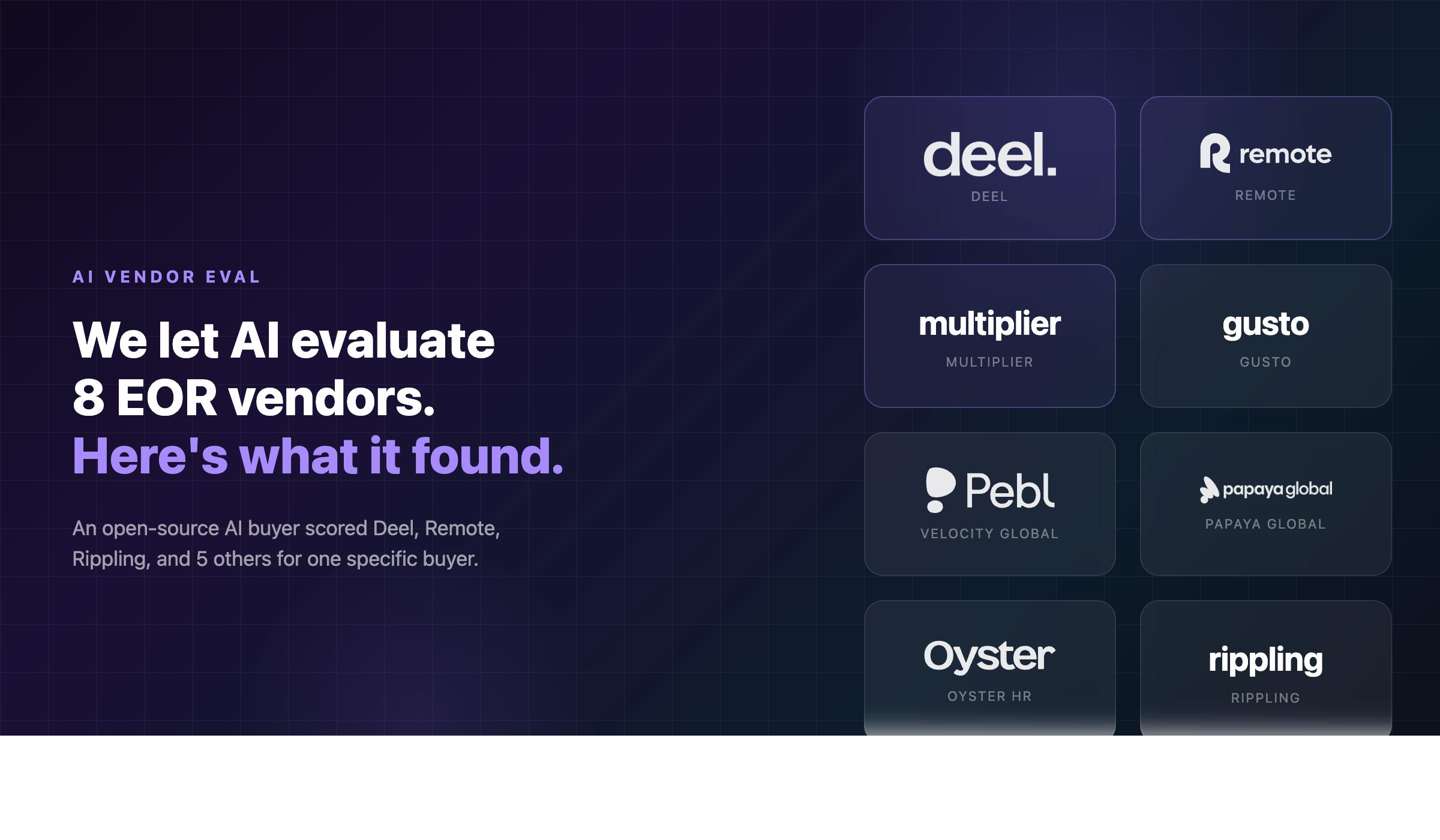
Eight vendors evaluated: Deel, Rippling, Remote, Papaya Global, Oyster HR, Multiplier, Velocity Global (now Pebl), and Gusto. Each scored 1-5 on 7 weighted dimensions: product fit, integration, pricing, security, vendor credibility, customer evidence, and support. All scoring based on publicly available evidence only -- the same pool of information an AI evaluator would have today.
Results for this buyer
| Rank | Vendor | Score | Fit for this buyer |
|---|---|---|---|
| 1 | Deel | 4.05 | Best fit |
| 2 | Remote | 3.93 | Strong fit |
| 3 | Multiplier | 3.85 | Strong fit |
| 4 | Gusto | 3.30 | Different fit |
| 5 | Velocity Global / Pebl | 3.23 | Different fit |
| 6 | Papaya Global | 3.14 | Different fit |
| 7 | Oyster HR | 3.06 | Different fit |
| 7 | Rippling | 3.06 | Different fit |
Why each landed where it did -- for this buyer
Deel (4.05) -- best fit. Only vendor checking every hard constraint. Owned entities in all 5 markets, native BambooHR integration, published pricing inside the buyer's stated range, documented 4-day Germany onboarding. 12,400+ G2 reviews at 4.8 stars contributes to high confidence.
Remote (3.93) -- strong fit. Deepest BambooHR integration in the eval, 100% owned-entity model, premium benefits at no markup. One open question on Philippines coverage that the AI couldn't resolve from public sources -- exactly the kind of thing an agent-to-agent query would answer in seconds.
Multiplier (3.85) -- strong fit. Best price ($400/mo) and the strongest security stack of the 8 (ISO 27001:2022, SOC 2 Type II, ISO 27017, ISO 27018). Trade-off: Germany and the Netherlands served through unnamed local partners rather than owned entities.
Gusto (3.30) -- different fit. No native BambooHR integration. Gusto's EOR is also white-labeled from Remote, meaning a buyer who picks Gusto for EOR pays a markup for infrastructure they could source directly. For a different buyer (US-only payroll, no existing HRIS), Gusto is a strong choice.
Velocity Global / Pebl (3.23) -- different fit. Three CEOs and three CROs in three years, multiple layoff rounds, recent rebrand. Notable: Pebl is the only one of the 8 with a public chatbot on their marketing site (Alfie) -- forward-thinking, though Alfie is designed for human interaction and isn't queryable by visiting AI agents.
Papaya Global (3.14) -- different fit. Strong payroll analytics but pricing opacity that pushes the actual cost above this buyer's stated budget. For a buyer with a higher budget who weights payroll BI, Papaya could rank much higher.
Oyster HR (3.06) -- different fit. Deepest contract-change sync of any BambooHR integration in the eval, but the highest published price ($699/mo) combined with three layoff rounds in three years.
Rippling (3.06) -- different fit, right vendor for the wrong project. Rippling is architecturally a BambooHR replacement. For a buyer willing to replace BambooHR (or who doesn't have it yet), Rippling probably wins this category outright -- strong product, 4.8 G2 rating across 10,000+ reviews, $16.8B valuation. For this buyer, the BambooHR requirement is the disqualifier.
What this means for B2B marketing and sales leaders
If you run marketing at any B2B SaaS, your site is being crawled by AI agents right now. You can't see it in GA4. You can't see it in HubSpot. You can see it with Agent Analytics, which we built for exactly this problem -- it's free, it runs in under a minute, and it'll show you which models are reading your site, which pages they're reading, and how often.
Once you can see it, the next question is what you do about it. We built Salespeak for that part: an agent-to-agent protocol that sits on your marketing site and lets visiting AI evaluators (and the buyers asking them questions) query your authoritative product information directly. Instead of being scraped, you're answering.
The buyer-eval skill we used for this post is open source. Run it on your own category, for your own buyer.
Omer Gotlieb is co-founder and CEO of Salespeak, building the Company Agent layer for B2B companies in an agent-first world. Previously co-founded Totango.