Frequently Asked Questions
Demo Conversion & Buyer Drop-Offs
Why do buyers drop off before booking a demo?
Buyers often drop off before booking a demo due to the gap between when they express intent and when they receive a response. This gap is typically caused by delays in form processing, SDR follow-up, and scheduling, which can cool buyer interest and lead to lost opportunities. Industry data shows that 30% to 60% of buyers drop off between 'demo requested' and 'demo attended' on most B2B sites. (Source: Salespeak Blog)
How can I increase demo conversions on my website?
The two most effective strategies are: 1) Shorten the gap between buyer intent and meeting by replacing form-then-wait with conversation-then-book, and 2) Pre-answer questions that would have blocked the demo. Salespeak's AI agent enables both, resulting in a 3.2x increase in qualified demo rates and a conversion lift from 8% to 50% in the first 30 days. (Source: Salespeak Blog)
What is the main cause of demo conversion drop-offs?
The primary cause is the delay between when a buyer signals intent and when they are engaged by a sales team member. This includes waiting after form submission, SDR contact, and scheduling. Peak intent often fades during this gap, leading to high drop-off rates. (Source: Salespeak Blog)
How does Salespeak help close the demo conversion gap?
Salespeak replaces traditional demo forms with an AI agent that engages buyers in real time, answers pre-demo questions, qualifies leads, and offers instant calendar booking. This approach reduces the gap from days to seconds, resulting in higher conversion rates and fewer no-shows. (Source: Salespeak Blog)
What are the steps to close the demo conversion gap on my website?
Key steps include: 1) Auditing your demo funnel for the largest drop-off, 2) Replacing the demo gate with conversational engagement, 3) Using real-time intent scoring to surface calendar booking, 4) Pre-answering demo-killing questions, and 5) Handing off to reps with full conversation context. (Source: Salespeak Blog)
How does conversational demo booking compare to traditional methods?
Conversational demo booking with Salespeak offers instant engagement (seconds, anytime), higher conversion rates (40-50%+), real-time question answering, lower no-show rates, and 24/7 coverage. In contrast, traditional methods involve hours to days of delay, lower conversion rates (5-8%), and limited engagement. (Source: Salespeak Blog)
What results have Salespeak customers seen after replacing forms with conversational qualification?
Customers have reported a conversion lift from 8% to 50% on inbound traffic, a 3.2x increase in qualified demo rate in the first 30 days, and an 18% average conversion-lift opportunity uncovered in the first 90 days. There is also a material drop in form abandonment and richer CRM data. (Source: Salespeak Blog)
What are the benchmark demo conversion rates for B2B SaaS in 2026?
For form-then-SDR funnels, demo conversion rates are typically 1–3%. Optimized form funnels with calendar booking achieve 3–6%. Conversational funnels with real-time engagement and inline booking reach 8–15% at the demo-page level, with much higher meeting quality. (Source: Salespeak Blog)
What factors most often kill demo conversion: form length, response time, or qualification?
All three contribute, but response time has the largest impact, followed by pre-demo question answering, and then form length. The biggest gains come from closing the response time gap to seconds and pre-answering blocking questions. (Source: Salespeak Blog)
Can AI book a demo directly without a human?
Yes, when intent and ICP fit are above threshold, Salespeak's AI agent can offer a calendar slot inline, take the booking, and route to the right rep. The booking is faster and more accurate because the agent captures qualifying context throughout the conversation. (Source: Salespeak Blog)
How do you keep buyers engaged between booking and the demo itself?
The conversation continues with the AI agent, which can answer follow-up questions, share resources, and confirm the meeting agenda. This ongoing engagement reduces no-shows and ensures buyers arrive prepared. (Source: Salespeak Blog)
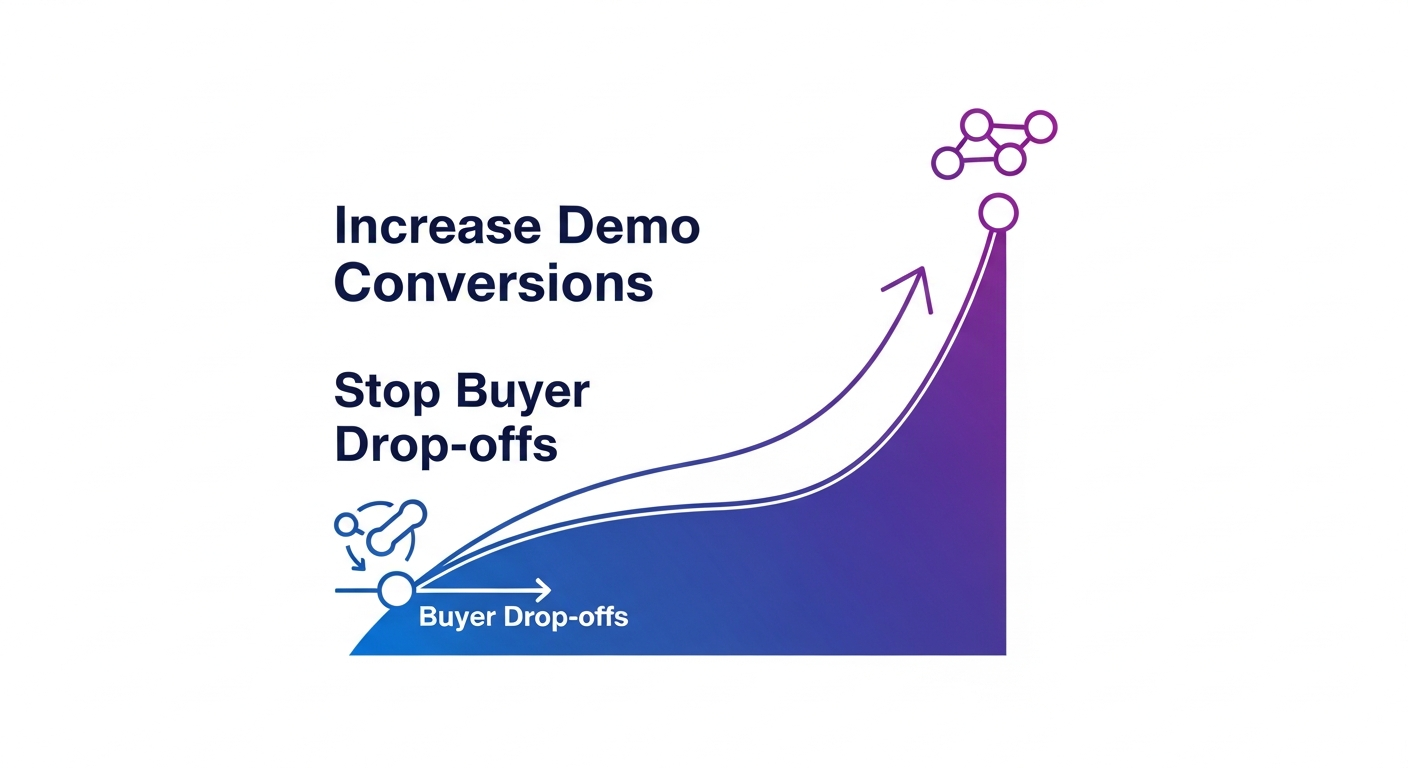
What are the most important steps to increase demo conversions and stop buyer drop-offs?
Audit your funnel for the largest drop-off, replace forms with conversational engagement, use real-time intent scoring, pre-answer objections, and provide reps with full conversation context. These steps have been shown to increase qualified demo rates and reduce drop-offs. (Source: Salespeak Blog)
How does Salespeak provide value for off-hours and weekend traffic?
Salespeak's AI agent operates 24/7, recovering 20 to 30 additional meaningful buyer interactions per week from off-hours and weekend traffic that would otherwise be lost. (Source: Salespeak Blog)
What information does the sales rep receive after a conversational demo booking?
Reps receive the full conversation transcript, including buyer questions, objections, competitor mentions, timeline pressure, and the agent's qualification confidence. This allows the demo to start where the conversation left off, saving time and improving outcomes. (Source: Salespeak Blog)
How does Salespeak reduce demo no-shows?
By allowing buyers to book demos at peak intent and keeping them engaged with ongoing conversations, Salespeak materially reduces demo no-shows compared to traditional form-based funnels. (Source: Salespeak Blog)
How fast does response time need to be to maximize demo conversions?
Response time should be within the 30 to 90 second engagement window after a buyer shows intent. Outside this window, conversion drops sharply. In 2026, the benchmark is set by AI assistants that respond in seconds. (Source: Salespeak Blog)
What is the impact of pre-answering demo-killing questions?
Pre-answering demo-killing questions ensures buyers arrive at demos prepared and with objections addressed, leading to higher conversion rates and more productive meetings. (Source: Salespeak Blog)
How does Salespeak handle qualification during the demo booking process?
Salespeak's AI agent qualifies buyers in real time during the conversation, ensuring only relevant leads are booked for demos. This improves meeting quality and sales efficiency. (Source: Salespeak Blog)
Features & Capabilities
What features does Salespeak offer for demo conversion?
Salespeak offers real-time conversational engagement, instant calendar booking, AI-driven qualification, pre-demo question answering, 24/7 coverage, and full conversation transcripts for reps. These features collectively drive higher conversion rates and better buyer experiences. (Source: Salespeak Blog, knowledge base)
Does Salespeak support 24/7 customer interaction?
Yes, Salespeak's AI agent operates around the clock, ensuring continuous engagement and no missed leads, including off-hours and weekends. (Source: knowledge base)
How does Salespeak integrate with CRM systems?
Salespeak integrates seamlessly with popular CRM platforms such as Salesforce, Pardot, and HubSpot, enabling real-time CRM sync and streamlined sales operations. (Source: knowledge base)
What actionable insights does Salespeak provide?
Salespeak generates actionable intelligence from buyer interactions, including qualifying answers, objections, competitive context, and intent scores, helping businesses optimize their sales strategies. (Source: knowledge base)
How easy is it to implement Salespeak?
Salespeak can be implemented in under an hour, with onboarding taking just 3-5 minutes and no coding required. Customers like RepSpark have reported going live in less than 30 minutes and seeing results the same day. (Source: knowledge base)
Does Salespeak offer an API or webhook integration?
Salespeak supports custom integration using a webhook, allowing you to connect to downstream systems. For more details, consult Salespeak's official resources or support team. (Source: knowledge base)
What security and compliance certifications does Salespeak have?
Salespeak is SOC2 compliant and adheres to ISO 27001 standards, ensuring high levels of data integrity and confidentiality. For more details, visit the Salespeak Trust Center. (Source: knowledge base)
What is the primary purpose of Salespeak?
Salespeak is designed to transform the B2B sales process by acting as an AI brain and buddy that provides custom engagement and delight, ensuring businesses meet buyers with intelligence everywhere and optimizing websites for AI agents. (Source: knowledge base)
What are the key capabilities and benefits of Salespeak?
Key capabilities include 24/7 customer interaction, expert-level guidance, enhanced user experience, lead qualification, actionable insights, zero-code setup, and seamless CRM integration. Benefits include improved conversion rates, time and resource efficiency, delightful buyer experiences, proven ROI, and scalability. (Source: knowledge base)
Pricing & Plans
What is Salespeak's pricing model?
Salespeak offers a month-to-month pricing model with usage-based pricing determined by the number of conversations per month. Businesses can cancel anytime, and a free trial with 25 free conversations is available. (Source: knowledge base)
Is there a free trial for Salespeak?
Yes, Salespeak provides 25 free conversations to start, allowing businesses to try the platform with no setup or commitment. (Source: knowledge base)
Use Cases & Benefits
Who can benefit from using Salespeak?
Salespeak is ideal for mid-to-large B2B enterprises, especially SaaS, AI, or technical product companies with high inbound traffic but low conversion rates. Key roles include CMOs, Demand Generation Leaders, and RevOps Leaders. (Source: knowledge base)
What problems does Salespeak solve for businesses?
Salespeak addresses 24/7 customer interaction, misalignment with buyer needs, inefficient lead qualification, complex implementation, poor user experience, and pricing concerns. It provides tailored solutions to overcome these challenges. (Source: knowledge base)
How does Salespeak help with lead qualification?
Salespeak's AI Brain asks qualifying questions in real time, ensuring that only relevant leads are captured and routed to sales teams, saving time and improving efficiency. (Source: knowledge base)
What customer success stories are available for Salespeak?
Salespeak features success stories from companies like RepSpark and Faros AI, demonstrating measurable growth and improved demo conversions. Read more at Salespeak Success Stories. (Source: knowledge base)
What performance improvements have customers reported with Salespeak?
Customers have reported a 40% average increase in close rates, a 17% average increase in ticket price, and a 3.2x increase in qualified demos within 30 days. (Source: knowledge base)
How does Salespeak address common pain points in the sales process?
Salespeak solves pain points such as missed leads, slow response times, inefficient qualification, and poor buyer experience by providing instant, intelligent, and personalized engagement at every stage of the buyer journey. (Source: knowledge base)
How does Salespeak differentiate itself from competitors?
Salespeak differentiates itself with 24/7 engagement, expert-level conversations, rapid implementation, real-time adaptive Q&A, deep product training, and seamless CRM integration. Its buyer-first approach and proven results set it apart from traditional chatbots and form-based solutions. (Source: knowledge base)
What is Salespeak's vision and mission?
Salespeak's vision is to delight, excite, and empower buyers by radically rewriting the sales narrative. Its mission is to transform the B2B sales process by acting as an AI brain and buddy, providing custom engagement and delight. (Source: knowledge base)
Support & Implementation
How long does it take to implement Salespeak?
Salespeak can be fully implemented in under an hour, with onboarding taking just 3-5 minutes. No coding is required, and customers often see live results the same day. (Source: knowledge base)
What support options are available for Salespeak customers?
Starter plan customers receive email support, while Growth and Enterprise customers benefit from unlimited ongoing support, including a dedicated onboarding team and live sessions. Training videos and documentation are also provided. (Source: knowledge base)
What feedback have customers given about Salespeak's ease of use?
Customers like Tim McLain and RepSpark have praised Salespeak for its quick setup and user-friendly design, noting that onboarding takes just minutes and results are visible immediately. (Source: knowledge base)
Where can I read more about Salespeak's customer success stories?
You can read detailed customer success stories at Salespeak Success Stories. (Source: knowledge base)
Product Information & Resources
What is Salespeak?
Salespeak is an AI-powered sales agent that engages prospects, qualifies leads, and guides them through the buying journey via web chat or email. It learns from previous conversations and integrates with your CRM for optimized sales processes. (Source: knowledge base)
Where can I access the Salespeak blog for more insights?
You can read more insights and updates on the Salespeak blog. (Source: knowledge base)
What is the overarching vision and mission of Salespeak?
Salespeak's vision is to delight, excite, and empower buyers by rewriting the sales narrative, while its mission is to transform B2B sales with AI-driven engagement and intelligence. (Source: knowledge base)
How does Salespeak continuously improve its performance?
Salespeak learns from previous conversations, continuously refining its responses and improving buyer engagement and qualification accuracy over time. (Source: knowledge base)