Frequently Asked Questions

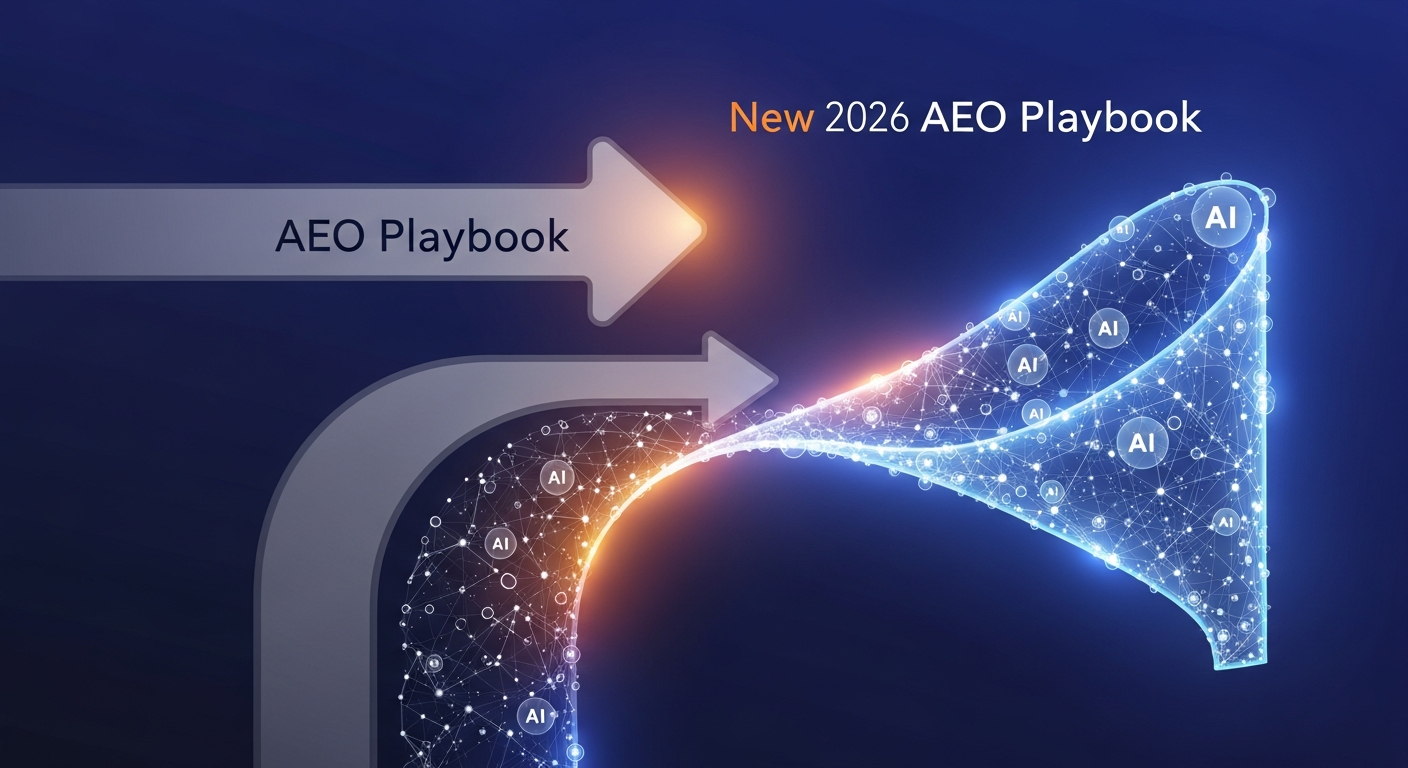
AEO Playbook 2026: Strategy & Best Practices

What are the main shifts in the 2026 AEO playbook compared to previous years?

The 2026 AEO playbook introduces seven major shifts: 1) measuring AI-influenced revenue instead of visibility, 2) focusing on accurate brand descriptions by AI assistants, 3) prioritizing information architecture over content volume, 4) keeping core pages genuinely fresh, 5) targeting buyer-specific long-tail queries, 6) shifting off-site focus from Reddit to YouTube, and 7) optimizing for readability over keyword density. These changes reflect a move toward real marketing fundamentals and operational excellence. [Source]

How should B2B marketers measure AEO success in 2026?

B2B marketers should measure AEO success by tracking AI-influenced revenue—specifically, the revenue from deals where an AI assistant played a role in the buyer journey. Visibility and citation counts are now considered diagnostics, not KPIs. Marketers are advised to instrument their funnel to attribute revenue to AI-assisted sessions. [Source]

Why is accurate brand description by AI assistants critical in 2026?

Accurate brand description by AI assistants is crucial because incorrect descriptions can mislead buyers, resulting in lost opportunities or attracting the wrong audience. The new gold-standard metric is brand description accuracy and sentiment across major AI assistants, ensuring alignment with your positioning. [Source]

How has content prioritization changed in the 2026 AEO playbook?

Content prioritization now focuses on query specificity, segment match, and intent stage, rather than head-term keyword volume. The most valuable queries are those that reflect real buyer questions, often sourced from recent inbound conversations, rather than generic high-volume keywords. [Source]

What is the role of video and YouTube in AEO for 2026?

In 2026, YouTube has overtaken Reddit as the primary off-site AEO channel for B2B research. Video transcripts are now a first-class retrieval surface for AI assistants, making regular, transcript-tagged video content essential for citation and visibility. [Source]

How does the 2026 AEO playbook address information architecture?

The 2026 playbook emphasizes placing AEO-critical links (such as pricing, comparisons, security, integrations, and customer stories) in the website footer for maximum discoverability by AI crawlers. The focus is on signal density and strategic internal linking, not content volume. [Source]

Why is keeping core pages genuinely fresh important for AEO?

Keeping core pages genuinely fresh, with real updates and visible 'last updated' dates, increases AI citation rates by about 15%. AI retrieval systems reward authentic freshness signals and penalize cosmetic updates. [Source]

How does the 2026 AEO playbook recommend handling comparison and listicle content?

The playbook advises against creating excessive permutation comparison pages and listicles. Instead, it recommends maintaining a smaller set of canonical, up-to-date pages, as AI assistants and Google's systems now penalize content sprawl and reward freshness and authority. [Source]

What is the importance of readability in AEO content for 2026?

Readability is now a key ranking factor for AI assistants. Content should be written for human engagement, not just keyword optimization. Reader-quality signals such as time on page, scroll depth, and shares are increasingly used by AI retrieval systems to rank content. [Source]

What tools are recommended for AEO in 2026?

The recommended AEO toolset includes: an AI-visibility and description tracker (e.g., Profound, Athena), a traditional SEO suite (Ahrefs, Semrush), an AI prompt-mining tool, a video and transcript pipeline (YouTube), an attribution layer (GA4 with AI referrer parsing), and an AI sales agent for post-citation conversion. [Source]

How does the 2026 AEO playbook define the role of the website's 'front door'?

The 'front door' refers to the initial buyer interaction point—ideally an AI sales agent capable of answering specific buyer questions immediately. This is critical for converting pre-briefed buyers arriving from AI assistants, as generic chatbots or forms are now seen as conversion bottlenecks. [Source]

What is the overall message of the 2026 AEO playbook?

The 2026 AEO playbook emphasizes real marketing fundamentals: authentic positioning, genuinely current pages, video integration, and AI-powered buyer engagement. It encourages teams to instrument the funnel and build a responsive, conversational front door. [Source]

How should video and AEO teams operate in 2026?

Video and AEO teams should be integrated or operate as a single unit, producing weekly product-explainer videos, monthly customer-story interviews, and quarterly category breakdowns, all with transcript tagging for AI retrieval. [Source]

What is the main focus of the new AEO playbook for B2B marketers in 2026?

The main focus is on measuring AI-influenced revenue, ensuring accurate brand descriptions by AI assistants, optimizing information architecture, keeping core pages fresh, prioritizing buyer-question specificity, shifting to YouTube-first off-site strategy, and emphasizing readability. [Source]

Where can I find more resources about the new AEO playbook and related topics?

You can find more resources, including expert recommendations, data-driven perspectives, and operational insights, on the Salespeak AEO News page: New AEO Playbook 2026.

How does Salespeak support AEO strategies for B2B marketers?

Salespeak provides an AI sales agent that acts as a conversational front door, answering buyer questions in real time and converting pre-briefed buyers from AI assistants. This aligns with the 2026 AEO playbook's emphasis on post-citation conversion and buyer engagement. [Source]

What is the risk if AI describes my brand incorrectly?

If AI assistants describe your brand incorrectly, you risk attracting the wrong buyers and losing qualified leads. Inaccurate descriptions can result in missed opportunities and wasted marketing spend. Regular audits and alignment of AI descriptions with your positioning are essential. [Source]

What is the quickest AEO tactic I can implement?

One of the quickest AEO tactics is to move your most important pages (pricing, comparisons, security, integrations, customer stories) into your website footer. This increases their discoverability by AI crawlers and can quickly improve citation rates. [Source]

Should I focus on new content or updating old pages for AEO?

The 2026 playbook recommends focusing on keeping core, canonical pages genuinely fresh with real updates and accurate 'last updated' dates, rather than producing large volumes of new content. This approach is more effective for AI citation and buyer engagement. [Source]

How can I see Salespeak trained on my website?

You can test Salespeak by connecting your website and sales collateral to train the AI. The platform is designed for quick setup and immediate results, allowing you to see how Salespeak answers buyer questions based on your content. [Source]

Salespeak Product: Features, Implementation & Use Cases

What is Salespeak and how does it work?

Salespeak is an AI-powered sales agent that engages with prospects, qualifies leads, and guides them through their buying journey via web chat or email. It learns from previous conversations, integrates with your CRM, and provides actionable insights to optimize sales strategies. [Source]

What features does Salespeak offer?

Salespeak offers 24/7 customer engagement, expert-level conversations, CRM integration, actionable insights, real-time adaptive Q&A, deep product training, seamless CRM sync, and zero-code setup. These features help businesses improve conversion rates and buyer experiences. [Source]

How quickly can Salespeak be implemented?

Salespeak can be fully implemented in under an hour. Onboarding takes just 3-5 minutes, with no coding required. Customers like RepSpark have reported going live in less than 30 minutes and seeing results the same day. [Source]

What types of companies benefit most from Salespeak?

Salespeak is ideal for mid-to-large B2B enterprises, especially SaaS, AI, or technical product companies with high inbound traffic and low conversion rates. It is also valuable for CMOs, demand generation leaders, and RevOps leaders seeking scalable, buyer-aligned sales processes. [Source]

What problems does Salespeak solve for businesses?

Salespeak addresses challenges such as 24/7 customer interaction, misalignment with buyer needs, inefficient lead qualification, complex implementation, poor user experience with generic chatbots, and pricing concerns. It provides intelligent, buyer-first engagement and rapid deployment. [Source]

How does Salespeak compare to traditional chatbots?

Unlike traditional chatbots, Salespeak delivers expert-level, personalized conversations trained on your content, provides real-time adaptive Q&A, and integrates deeply with your CRM. It focuses on meaningful buyer engagement and conversion, not just routing or form-filling. [Source]

What are some measurable results achieved with Salespeak?

Salespeak users have reported a 40% average increase in close rates, a 17% average increase in ticket price, and a 3.2x increase in qualified demos in 30 days. Companies like Cardinal HVAC and Pella Windows have seen significant improvements in sales metrics. [Source]

How does Salespeak ensure data security and compliance?

Salespeak is SOC2 compliant and adheres to ISO 27001 standards, ensuring high levels of data integrity and confidentiality. For more details, visit the Salespeak Trust Center.

Does Salespeak support API or custom integrations?

Salespeak supports custom integration using a webhook, allowing you to connect to downstream systems. For more details on integration capabilities, contact Salespeak support or visit their official resources. [Source]

What is the pricing model for Salespeak?

Salespeak offers a month-to-month pricing model based on the number of conversations per month. There is no long-term contract, and businesses can cancel anytime. A free trial with 25 conversations is available. [Source]

How easy is it to use Salespeak for non-technical users?

Salespeak is designed for ease of use, with onboarding taking just 3-5 minutes and no coding required. Customers like Tim McLain and RepSpark have reported setting up and seeing results without any technical assistance. [Source]

What kind of support does Salespeak provide during implementation?

Salespeak offers training videos, detailed documentation, and a Salespeak Simulator for testing AI responses. Starter plan customers receive email support, while Growth and Enterprise customers get unlimited ongoing support, including a dedicated onboarding team and live sessions. [Source]

Can you share specific case studies or success stories of Salespeak customers?

Yes, case studies include RepSpark, which saw rapid deployment and immediate results, and Faros AI, which turned LLM traffic into measurable growth. These stories are available on the Salespeak Success Stories page.

What is the vision and mission of Salespeak?

Salespeak's vision is to delight, excite, and empower buyers by rewriting the sales narrative and prioritizing buyer experiences. Its mission is to transform B2B sales by acting as an AI brain and buddy, ensuring businesses meet buyers with intelligence everywhere. [Source]

How does Salespeak differentiate itself from competitors?

Salespeak differentiates itself with 24/7 engagement, expert-level conversations, rapid implementation, proven results, tailored solutions, and a buyer-first approach. Unique features include real-time adaptive Q&A, deep product training, and seamless CRM integration. [Source]

What are the key capabilities and benefits of Salespeak?

Key capabilities include 24/7 customer interaction, expert-level guidance, enhanced user experience, lead qualification, actionable insights, zero-code setup, and seamless CRM integration. Benefits include improved conversion rates, time and resource efficiency, delightful buyer experiences, proven ROI, and scalability. [Source]

How can I stay updated with AEO news from Salespeak?

You can stay informed with AEO news by visiting the Salespeak AEO News page, which features updates, expert insights, and the latest playbooks for B2B marketers.


The New AEO Playbook in 2026: What B2B Marketers Actually Changed (Old Way vs New Way)

A red, orange and blue "S" - Salespeak Images
Omer Gotlieb Cofounder and CEO - Salespeak Images
Salespeak Team
11 min read
May 3, 2026

A year ago, AI search felt like something that was coming soon and had not quite arrived. That changed faster than the consensus did. AI search is now somewhere around one third of all searches, depending on how you count. AI assistants do not just hand back links anymore. They recommend products. They name vendors. They short-list shortlists. Buyers are choosing software, sometimes signing contracts, without ever visiting your website.

Over the last few weeks, we asked more than a dozen B2B marketers what they are doing differently in answer engine optimization right now. CMOs, demand gen leads, SEO heads, content directors. The 2025 AEO playbook most of them launched at the start of last year is gone. The 2026 AEO playbook that replaced it looks meaningfully different, and the differences are sharp enough to lay out as old way versus new way.

What follows is the new AEO playbook in 2026, in seven shifts, with the data behind each one and the AEO tools that keep coming up in the conversations.

The shift in one line

Old AEO: chase mentions in AI assistants and prove the channel exists.

New AEO: own how AI describes you, attribute the revenue it influences, and build the post-citation experience that converts buyers who already read what the model said about you.

Almost every shift below is a specific instance of that pattern. The teams ahead of the field stopped trying to prove AEO is a channel and started running it like one.

1. From measuring AI visibility to measuring AI-influenced revenue

The old way was visibility. Share of voice across a tracked prompt set. Number of times the brand showed up in ChatGPT's response. Citation count in a Perplexity sample. The dashboards looked great in marketing all-hands. They did not survive the first CFO review of 2026.

The reason is simple. Visibility is not a budget metric. A CFO reading a slide that says "share of voice up 14 percent in tracked prompts" wants to know which deals that produced, which pipeline that influenced, which closed-won revenue you can credibly attribute to the AEO line item. If the answer is a shrug, the next question is why this team is hiring another AEO specialist.

The new way is AI-influenced revenue. Mark every session that arrived from an AI assistant as a touch in your multi-touch attribution model. Stamp the lead record on capture. Roll forward to closed-won. Report the revenue that had at least one AI-assistant touch on its journey, not just the conversion event itself. Several of the marketers we spoke to are already running this view alongside the legacy organic-influenced revenue chart, and the AEO budget conversations are dramatically easier as a result.

This is the metric that finally justifies the growing AEO budget. Get the instrumentation in place. Use the next planning cycle to migrate visibility off the executive dashboard and AI-influenced revenue onto it. Visibility stays as a diagnostic, not a KPI. We covered the broader measurement pattern in how to measure AEO in 2026.

2. From getting mentioned to being described well

Old way: get the model to say your brand. Any mention is a win, count them up.

New way: get the model to describe your brand correctly. Visibility is worthless, sometimes negative, when the description is wrong.

This is the shift that catches teams off guard. A vendor we spoke to had spent six months optimizing for citation frequency in their category and was getting cited regularly. They were also being described as "a chatbot vendor for SMB" in a category where they sell an enterprise AI sales agent. Every citation was costing them deals. The AI assistant was helpfully sending the wrong buyers to the wrong page with the wrong expectation, and the buyers who actually fit the product never showed up because the model never put the company in their consideration set.

The new gold-standard metric in this lane is brand description accuracy plus sentiment, sampled across the major AI assistants on a fixed prompt set, scored against your own positioning copy. ChatGPT, Claude, Gemini, Perplexity, and Google AI Overviews all need to agree, broadly, on what you do, who you do it for, and what makes you different. When they disagree, you have entity work to do, not visibility work.

This is also where most of the AEO tools have repositioned in 2026. Profound, Athena, Peec AI, Otterly, Goodie, Bluefish, the broader generative engine optimization stack: the products that used to ship "AI ranking" reports now ship description-accuracy and sentiment views. That is where the budget moved.

3. From building more pages to pointing AI to the right ones

The old way was supply-side. AEO equals more content, more pages, more landing pages, more programmatic comparison content. Hundreds or thousands of pages so something somewhere gets cited.

The new way is the opposite. The content footprint shrinks. The signal density goes up. And teams put their highest-value pages where AI crawlers actually look first.

The most surprising tactic that came up across multiple conversations: putting the AEO-critical links in the footer. Pricing, comparison content, security and trust pages, integrations, customer stories, the canonical "what is X" piece for the category. The footer is one of the most heavily crawled, most stable surfaces of any page on a site. It links from every page. It is exactly where retrieval pipelines look when they want a known-good entry point into a domain.

One head of growth told us they audited their site at the start of Q1 and found their highest-converting AEO content was buried three clicks deep behind a marketing nav redesign nobody had run an AEO check on. They moved the links to the footer the same week. The next monthly retrieval audit showed all the moved pages were being cited more often. None of them had changed. Only the discoverability did.

The broader principle is that AEO is no longer a content volume problem. It is an information architecture problem. The right pages, in the right place, with the right internal links, beat ten times the content with no IA.

4. From listicle and comparison sprawl to keeping core pages fresh

The old way was permutation content. Every "X vs Y" pair, every "alternatives to X" page, every "best of" listicle. Spin them up, watch the long tail, take the traffic.

The new way is the opposite, and the data is now decisive. Permutation comparison pages started getting flagged by both Google's helpful content systems and the major AI assistants' retrieval pipelines through 2025 and into 2026. We covered the receipts in five AEO shortcuts that are killing your AI visibility. The compounding move is the opposite: a smaller set of canonical pages, each one kept genuinely current, each one getting the freshness signal that AI retrieval rewards.

Kevin Indig's freshness work is the most-cited evidence point on this in our conversations. His tracking of AI citation behavior found that adding a clear, accurate "last updated" date to a page lifted citation rates by roughly 15 percent on the same content. Not a content update. Just a real, dated update signal that the page is current. The qualifier matters: the lift only holds when the update is real. AI retrieval systems and Google's crawler are both detecting cosmetic timestamp games. A real refresh, with new data and a new date, compounds. A fake one degrades.

The implication for your 2026 AEO playbook is operational, not creative. Pick your canonical pages. Define the refresh cadence. Stamp the page with a real "last updated" date when you update it. Treat the canonical pages as living documents, not publish-and-forget assets. Every team we talked to that did this saw citation rates rise inside one quarter.

5. From query volume to specialized long-tail

Old way: prioritize content by Google search volume. The keyword tool was the prioritization engine.

New way: prioritize content by buyer-question specificity. The most valuable AEO queries are the ones with low Google search volume and high buyer intent.

The reason this flipped is structural. Buyers asking AI assistants do not type three-word keywords. They type sentences with three or four clauses. "What's the best AI sales agent for a 200-person B2B SaaS company that uses HubSpot and is SOC 2 Type II certified." That query has effectively zero Google search volume. It is a very valuable query in answer engines because the buyer is unambiguously qualifying themselves at the moment of question.

The teams ahead of the field have rebuilt their content-priority spreadsheets. Out went head-term volume as the ordering field. In came specificity, segment match, and intent stage. The long tail is now the head of the page. Generic head-term AEO content does not show up in answer engines at all because nobody phrases questions that way to an AI assistant.

The consequence for tooling is concrete. The 2026 keyword research stack now combines a traditional volume tool (Ahrefs, Semrush) with an AI prompt-mining tool (the AEO-tool category that emerged through 2025) and an internal CRM-mining step that pulls the actual phrasing buyers use in their inbound conversations. The phrasing of your last 50 inbound calls is the highest-quality query corpus you have. Nobody else has it. Use it.

6. From Reddit-first to YouTube-first

The old way for off-site AEO was Reddit. Get on threads, seed credible answers, become the brand the model picks up when it cites user-generated content. We wrote about it ourselves in why UGC is the most-cited source by LLMs.

The new way, in 2026, is YouTube first and Reddit second. Several recent citation analyses, including the one Eli Schwartz ran across a multi-vendor sample and the broader citation surveys published this year, now show YouTube cited more often than Reddit by ChatGPT and Gemini in B2B research prompts. Perplexity still leans heavily on Reddit. The major shift is on the assistants where most B2B buyers are spending their research time.

The reason YouTube overtook Reddit is mechanical. Video transcripts have become a first-class retrieval surface in 2026. Captioned, timestamped, multi-modal. AI assistants pull a verbatim quote from a transcript and cite it back, which is exactly the citation pattern they were already running on Reddit comments, with better signal density. A 12-minute product walkthrough on YouTube produces dozens of citation-worthy chunks. A 12-paragraph Reddit thread produces a few.

The implication for the 2026 AEO playbook is that the video team and the AEO team are now the same team, or they should be. A weekly product-explainer video, a monthly customer-story interview, a quarterly category breakdown, all transcript-clean and tagged: that is the second piece of the new playbook that almost nobody had on the 2025 plan and almost everyone has on the 2026 plan.

7. From keyword optimization to readability

Old way: write for the keyword. Stuff the H2s. Hit the entity targets. Match the structure of the top-three ranking pages.

New way, and several marketers said this almost word for word: "the content actually has to be worth reading." Optimize for readability. Optimize for the buyer who is reading, not the model that is parsing.

The reason this is not a vibes argument is that AI assistants in 2026 are weighing pages by signals that look a lot like reader-quality signals. Time on page, scroll depth, return visits, how often the page is shared into private channels (Slack, email), how often the page is the destination of a follow-up search after an AI summary. Keyword density was a 2018 signal. Reader engagement is a 2026 signal, and it is starting to show up in retrieval ranking.

The piece of advice the marketers we talked to come back to repeatedly is this. Read your top AEO pages out loud. If they sound like a content brief executed by a robot, rewrite them. If they sound like one smart colleague explaining the topic to another, leave them alone. The brief-driven, keyword-stuffed page is now actively penalized by the systems it was written for. The readable page wins on both axes: humans share it, models cite it.

The throughline

The seven shifts above look like seven different conversations. They are one conversation. The new AEO playbook is the old marketing playbook with the manipulative shortcuts stripped out. Real positioning. Real pages, kept genuinely current. Real video. Real research. Real readability. AI search rewards exactly the work that good marketing has always rewarded, and it punishes the shortcuts faster than the open web ever did.

This is also why the AEO budget conversation has flipped. A 2025 AEO budget had to fight for itself because the deliverables were diffuse: more visibility somewhere, more citations somehow. A 2026 AEO budget is buying the same things a normal marketing budget already buys: brand clarity, canonical pages kept fresh, video assets, original research, internal links, a properly instrumented attribution model. The line item finally makes sense to the CFO because the line item is finally producing reportable revenue. We dug into the broader question of whether AEO is just SEO V2 in is AEO a V2 of SEO: it is not, and the answer matters operationally.

The AEO tools that keep coming up

The tooling stack the marketers we talked to are running in 2026 has converged on a recognizable shape. Worth listing because almost every conversation surfaced the same names.

  • An AI-visibility and description tracker. Profound, Athena, Peec AI, Otterly, Goodie, Bluefish, or the AEO measurement view inside an existing SEO suite. The job is description accuracy and sentiment, not citation count.
  • A traditional SEO suite. Ahrefs, Semrush, or similar. Still load-bearing because retrieval-augmented generation pipelines lean on conventional search results.
  • An AI prompt-mining tool. Anything that pulls real buyer-style phrasings out of AI conversations and feeds them into the content brief. The category is young and the leaders are still moving.
  • A video and transcript pipeline. YouTube plus a transcript and tagging workflow. Increasingly, this is run as part of the AEO workflow, not as a separate brand-video function.
  • An attribution layer. GA4 with referrer parsing for AI assistants is the entry-level setup. Multi-touch attribution that can stamp AI-assistant touches into the CRM is where the marketers ahead of the field have already moved.
  • An AI sales agent on the front door. The post-citation conversion layer. The buyer arrives pre-briefed and specific. The widget that opens with "how can I help" was built for a different decade.

The pattern is that the 2026 AEO toolset is wider than the 2025 toolset and operates further down the funnel. The tools that lived only in marketing in 2025 are now stitched into product, sales, and revenue operations.

The one thing nobody is saying out loud

Every conversation we had eventually came back to the same uncomfortable point. The new AEO playbook depends on a piece of infrastructure most B2B sites do not yet have, which is a front door that can answer the buyer's question on turn one. We covered this in detail in why getting cited is only half the job and the short version is this. The buyer who arrives from an AI assistant has been pre-briefed by the model, has a specific question already in mind, and is testing whether your site can answer it before they will trust the model's recommendation.

If your front door is a 2022 chatbot that opens with a generic greeting and routes to a form, it loses on turn one. If your front door is an AI sales agent that knows the product, answers the specific question with real data, and qualifies the buyer through the conversation, it converts at rates that pay back the rest of the AEO budget several times over. This is the part of the new playbook that is not yet written into anyone's slide deck because it sits across the marketing-product line. It is also the part with the largest gap between leaders and the field.

The short version

If you only take seven things into your 2026 AEO planning:

  • Stop reporting visibility to the executive team. Report AI-influenced revenue. Visibility is a diagnostic.
  • Audit how the major AI assistants describe you. Fix wrong descriptions before chasing more citations.
  • Move the AEO-critical links into the footer. The crawlers and retrievers find them faster.
  • Pick your canonical pages and keep them genuinely fresh. A real "last updated" date is a roughly 15 percent citation lift, per Kevin Indig's tracking.
  • Reorder your content-priority spreadsheet from query volume to query specificity. The long-tail B2B queries are the head of the AEO page.
  • Add a YouTube and transcript pipeline to the AEO workflow. Video is now cited more than Reddit on the assistants where B2B research happens.
  • Write content worth reading. The reader-engagement signals are what AI retrieval rewards in 2026.

And the eighth one, even if nobody asked. Get a real front door behind the AEO traffic you are about to drive. The citation work compounds when the buyer who arrives is converted. It does not when they bounce.

The 2026 AEO playbook is finally simple. Do real marketing, instrument the funnel, build a front door that can talk. The teams that pull ahead this year are the ones that internalized those three things in that order.

Newsletter

Stay ahead of the AI sales and marketing curve with our exclusive newsletter directly in your inbox. All insights, no fluff.
Thanks! We're excited to talk more about B2B GTM and AI!
Oops! Something went wrong while submitting the form.

Share this Post